Sunday, July 5, 2026

My Favorite Yard Visitor

Male Hooded Oriole
Since I am to be laid up for a few more weeks I thought I'd write about my favorite annual visitor. We have lived in our house in Napa for nearly 30 years and every spring and summer we have been visited by Orioles. Interestingly enough for many years these were Bullock's Orioles with an occasional visit from a Hooded Oriole. In recent years however, that trend has been reversed. These days our spring and summer residents are almost all Hooded Orioles. They are nesting in the larger trees in our neighborhood some of which are palms. This species of Oriole is known to prefer palms for nesting. Hooded Orioles are very much a bird of the southwest. They spend their winters on both coasts of Mexico and the lower half of Baja California. For their nesting season they migrate to southern Texas, New Mexico, Arizona, Southern California, and the Central to Northern California Coast. The first ones begin to arrive in our area around the first week of April. Many of these birds are probably passing through and moving to nesting areas to the north of us. However some of them are our regular returnees back for another year to raise their young. They will stay in our area until early September when they and their newly fledged offspring will return south to the coasts of Mexico.

I put up a feeder especially for them which they eventually find and then continue to visit. Orioles are often seen at hummingbird feeders because they are nectar eaters too. However, due to their size it is difficult for them to effectively access the sugar water in the feeders. A special Oriole feeder will help with this. I keep the feeders clean and filled with sugar water mixed at a 4:1 ratio water:sugar. These birds are not uncommon here in California but most people don't even notice them. When you can get a closer look you will be surprised at the vibrant color of the male Hooded Oriole and wonder why you haven't noticed them before.

Over the last few days I have been photographing my resident birds as they have been visiting our backyard. Males, females, and first year birds are coming more and more regularly now. We will be able to enjoy their visits for a few more months before they are off to the warmer climates of coastal Mexico. Their visits cheer me up and make this time of recovery a little more bearable.

Female Hooded Oriole


Male Hooded Oriole


Saturday, June 20, 2026

A Promising Spring Interrupted

Over the past year I have tried to do more seabirding as I near species number 600 for North America. Towards the end of May I scheduled three different pelagic trips, two out of Fort Bragg (Noyo Harbor) and one out of Eureka (Humboldt Bay). My first trip was with Rob Fowler, a prominent Humboldt County birder who runs a regular schedule of pelagics out of Eureka. I persuaded my pal Michael Morris to join me for this one and I had one target bird that I needed to get on this trip. Murphy's Petrels are not common but they are somewhat regular off the north coast at this time of year. Also, there is always the remote possibility of a Short-tailed Albatross appearing mixed in with the many Black-footed Albatross we see off the coast of California. The seas were relatively calm for us as we motored through Humboldt Bay and out to sea. Overall bird numbers were lower than I expected but we ended up with a good mix of species. Both Sooty and Pink-footed Shearwaters, a fair number of Northern Fulmars, many Black-footed Albatross, and a surprising 8 Laysan Albatross. The star of the day was my target bird Murphy's Petrel. 8 were counted for the day most at some distance from the boat, however at our last slick of the day a couple came in close enough for decent views. We saw a total of 42 species on the day and as always, it was a joy to spend time birding with Michael.
My second trip was less than a week later on May 30th out of Fort Bragg with Noyo Pelagics. These trips are always fun because of the great group of Mendocino County birders who frequent them. Ocean conditions were predicted to be pretty rough and they did not disappoint. The thing is, the rougher the conditions and the higher the wind the better the conditions for Pterodroma. We saw fewer total species (38) than earlier in the week in Humboldt County but we saw many, many more birds and a couple of real stunners. By far our most counted species of the day was Sooty Shearwaters with over 4,000 of them passing within view. We also had excellent views of Murphy's Petrel with close to 30 individuals counted, many coming close for great views. For me it was a day with 3 new life birds making the challenging rough conditions well worth it. Peter Pyle who organizes these trips and boat captain Richard Thornton took their time in positioning the boat as far out as we needed to go to get us into the best position to see our hoped for birds. The first to appear was a Manx Shearwater that crossed our bow and did not stick around for good looks. This is a smaller shearwater with a dark back and white underparts and I got good enough looks through bins to help with the ID. I was not on the bow myself but halfway up the side and I immediately went to the front to confirm what I saw with those on the bow. My next lifer of the day was Hawaiian Petrel. Again these two birds did not stick around for good views and I only got the briefest of glimpses, however Roger Adamson was on the bow and got some diagnostic photos so we were certain of the id. Strangely enough, I was the first one on our boat to spot the real star of the day. I was on the bow with Tim Bray and Chuck Vaughn, two long-time Mendo birders. I was facing towards the rear of the boat, they towards the front as we chatted. I looked up to see the unmistakable form of a Booby passing over the boat from north to south. I shouted out, "Booby!" Tim spun around, got a look and shouted, "Nazca Booby!" and for a few minutes the boat was treated to the spectacle of this very cool bird. Nazca Boobies are common from Mexico to Peru and they show up occasionally off the California coast, however mostly Southern California coast. I believe this bird represented only the 4th Mendocino County record. What really made this bird special is that it was Chuck Vaughn's 400th Mendocino County bird, a real achievement for a really good guy!
But we weren't quite done yet. A little while after the Booby came by, Logan Kahle came running up from the back of the boat calling out a Least Tern, a bird that was a new county bird for most on board. We had fleeting glimpses of it as it made it's way north going who knows where.
Other good birds on the day were Laysan Albatross, Fork-tailed, Ashy and Black Storm Petrels, Northern Fulmars, Elegant Tern, Sabine's Gull, and a single South Polar Skua.
I was excited for my third and final pelagic trip of the spring with this same crew out of Noyo Harbor!
That was not to be as my birding/adventuring season came to a crashing halt, literally.
While finishing up a regular Sunday bike ride with the boys I had a pretty serious crash that resulted in a concussion and a fractured pelvis. I am now officially on the shelf as I slowly recover from this setback. I now sit at 594 North American species. I had thought that with the Montana trip to fish with my friend Brian Kelly I might get over that 600 mark but that will have to remain a goal. Here are a few images of our off-shore adventures.

Nazca Booby (Tim Bray)

Murphy's Petrel

Hawaiian Petrel (Roger Adamson)


Wednesday, May 13, 2026

Vagrants in Spring

Yellow-throated Warbler (image from Public Domain)

Springtime is such a joy to a person interested in birds. The weather is warming, the hills are green and full of spring flowers, and the birds are displaying their showiest plumages. It is also one of the two times of year (spring and fall migration) when you can expect a few birds to show up in your local area that are wildly off course from their normal haunts. These birds are called "vagrants". If you are a birder who is into the chase as I am then you will probably be plugged into the various social media channels that report these wanderers (ebird, list serves, etc.). Last week a report popped up of a Yellow-throated Warbler in San Francisco's Golden Gate Park. One of these had been showing well in Humboldt County but I couldn't make an escape to go see that one so this was my chance. I was in the truck 15 minutes after seeing the message and pulled up to the hotspot after a 1-hour drive. Another birder was there and as I walked up to her I asked if she had seen it. She said she could hear it high in the Eucalyptus trees and as I got close to her I saw some movement behind her about 1/2 way up the understory and there it was, a beautiful bright male. We followed it's movement for about 30 minutes, helping other birders locate it as they arrived. Conditions were very poor for photography so I will have no photo documentation of this sighting but that's not so important. This eastern warbler has eluded me on it's home territory so it was a special sighting to see it here in California.

Another springtime birding tradition I have maintained is a visit to Butterbredt Spring on the northern edge of the Mojave Desert. I had not made any birding plans for May as we had expected to be traveling but circumstances arose that required us to postpone that trip and now I had some time on my hands. My two regular companions for these trips, Michael and Jeff were busy with other things so I would make this trip on my own (however, I sorely missed their company).

I took a somewhat circuitous route going south driving out Mines Rd. from Livermore and then out to I-5 via Del Puerto Canyon Rd. This took me through some really beautiful country, all the while I was wishing I could be doing it on my bike! Plenty of Oak Titmouse, Black-headed Grosbeak, Yellow-billed Magpie and Acorn Woodpeckers but curiously absent of warbler species (granted I only stopped a few times as I had a long way to go). Then it was on to Kern National Wildlife Refuge where I drove the tour route and saw most of the usual suspects for this time of year. Of note were the large number of Cattle Egrets and a nesting pair of Common Gallinules. Quite a few Yellow and Wilson's Warblers as well.

Heading towards the Mojave I drove around Lake Isabella to Weldon and then south towards Butterbredt. I stopped briefly at Frog Springs to see if any migration wave had come over the ridge that day, my conclusion - no. Not many birds here. As I reached the intersection of Jawbone Canyon Rd. and Butterbredt Canyon Rd. I was greeted by a rather large rattlesnake guarding the entrance. I deftly navigated around him and made my way over the pass and on down to the spring. Not a lot of diversity in the migrants over the pass, mostly Western Tanagers. There was a pretty strong north wind blowing when I got to the spring and there were many warblers and tanagers in the Trees of Heaven seemingly waiting for things to calm down.  That evening and the next morning there was a significant wave of migrants coming up the canyon, stopping at the spring and then passing on. Warblers were Yellow, Yellow-rumped, Wilson's, Townsend's, Orange-crowned and a few Nashville. I was very surprised by a female Northern Parula, a bird I had never seen at Butterbredt before. As I walked down the canyon below the spring, migrating birds continued to pass for the rest of the morning. I photographed what I thought was a funny looking Wilson's Warbler but what turned out to be a female Hooded Warbler, another bird I had never seen at Butterbredt before. Later that day I met a Las Vegas birder named John Mark Simmons who said he had seen both of the rare warblers down in the spring as he sat by the water. He was kind enough to point out the differences between a female Hooded and a Wilson's, namely the white outer tail feathers. I went down into the spring and sat for a bit fighting off the mosquitos and was visited by both again. What a treat!

As is often the case in a migrant trap like Butterbredt Spring the next morning was pretty quiet. I had arrived as a wave was passing through and it was gone the next day. There were still a few good birds around. Loggerheaded Shrike, Cassin's Vireo, both Dusky and Hammond's Flycatchers, Ash-throated Flycatchers and several Costa's Hummingbirds. All in all another great visit to a special place. Returning to Bakersfield,  I took the long way and drove over Breckenridge Road. All the way over from the east side there were singing Lazuli Buntings and as I reached the forest on the top I wished I had more time to explore. It was beautiful up there. I finished up my trip with a stop for lunch and a quick visit with my mother-in-law and then back to Napa to wait for the next adventure.

See my trip list here.  Some photos from my adventure:


Hooded Warbler


Northern Parula


Western Cattle Egret


The Guardian of Butterbredt Canyon


Western Tanager


Lazuli Bunting


Great Horned Owl (hatch year)


Ash-throated Flycatcher


Yellow Warbler


Wilson's Warbler


Costa's Hummingbird


Bullock's Oriole

Tuesday, February 3, 2026

To Furnace Creek for a new Rarity


All winter long I have monitered the California Rare Bird list on e-bird and I've had my eye on a Ruddy Ground Dove that is overwintering at the Furnace Creek Resort in Death Valley National Park. Every few days it pops back onto the list as sightings are reported. While down visiting family in Bakersfield I had a chance to go off on a birding day and decided that it was worth the effort to make the drive over two mountain ranges and on down below sea level to try for this bird.

The Ruddy Ground Dove is a Central and South American species and a rare visitor to the American Southwest. Every winter you can usually turn one up somewhere in southeast Arizona but they rarely make it to California. With the weather being so mild at the beginning of the year here, it made for a lovely day out. Warm temperatures but still a dusting of snow atop Telescope Peak, the highest point in Death Valley.

I arrived at the resort area shortly before 10 am. and spent about 45 minutes searching before locating the bird roosting in a small tree in the lawn area between the swimming pool and the lodge. It did some flying back and forth before settling down on the grass to feed at one point flying up to perch in a small tree where I was able to get these images.

A beautiful little dove that takes me now to within 10 birds of 600. Perhaps 2026 will see me over this milestone.


Wednesday, October 8, 2025

Summer Pelagics and a North Pacific First!


I’ve seen some excitement blow up on a few rare birds I’ve chased but never anything like this. On a Redwood Region Ornithological Society Pelagic we saw a bird that has never been seen north of Costa Rica. It came up our wake and was first called out as a Laysan Albatross, however, as each moment passed and irregularities were pointed out, the excitement on the boat crescendoed into complete and utter pandemonium. The first ever sighting of a Waved Albatross in the North Pacific Ocean! After the initial explosion of excitement, back slapping, high fives and hugs our boat got down to the task of documenting the sighting. Fortunately, the bird stayed with us for a good 45 minutes. Thousands of photos were taken, I even managed a few like the one above. If you'd like to see more images taken by some excellent photographers, visit the link below to the official Ebird report of the
Redwood Region Ornithological Society here:

https://ebird.org/checklist/S277907962

A few details: Waved Albatross is considered critically endangered, they nest on the Galapagos and forage in the Humboldt Current off the coast of Peru. This is the first ever ABA record for this bird. How did it find its way here? God only knows. All I can really say is, “WOW!”


This summer I made a concerted effort to add more seabirds to my ongoing life list. I joined three different trips, two out of Bodega Bay with the Redwood Region Ornithological Society, and one with Noyo Pelagics out of Fort Bragg. All three of these trips had many outstanding birders with extensive knowledge of Pelagic species as well as several up-and-coming birders of note whose sharp eyes didn't miss a thing. These kinds of trips used to be difficult for me as I was prone to the onset of seasickness in all but the calmest of waters. Many people have had success with the use of Scopolamine patches so a few years ago I started using them and I haven't had a problem since. By any measure it was a successful summer. On each of my three trips I was able to add to my life list. The first trip came on July 15th and was out of Noyo Harbor in Fort Bragg. On this trip I added two Storm Petrels, Leach's and Least. The second was on August 24th out of Bodega Bay were three new species were seen, Script's Murrelet, Wilson's Storm Petrel, and Black Storm Petrel. Then the final trip of the season on October 5th where only one new species was added but man was it a special one.
I am now up to 589 ABA birds on my life list, slowly climbing to 600. I'm sure I will get there soon and then it will be time to set another goal to work towards. I do have to admit that one of the things I do enjoy about birding is the excitement of the chase. The experience of last Sunday took that to another level. You always go out hoping for something new but when we started our voyage none of us expected what turned up. It still gives me chills to think about. As I left the boat and walked towards the truck I hailed a visiting birder from the east coast who I had chatted with throughout the day, we said our goodbyes and he shook his head and just said, "Amazing, Amazing." It truly was that.

Monday, June 23, 2025

On a Cold Streak Through the American West

It's curious how birding can often mirror other hobbies, like hitting a baseball for example. Right now I feel like a baseball player whose average is below 200 and can't buy a hit. I'm on a streak of terrible luck. Danette and I recently took a trip out to Yellowstone to visit Pat. We had an enjoyable day with him visiting parts of the park that we hadn't seen before. Then, after leaving Yellowstone we made a big loop to the southeast to visit two other National Parks in Colorado that we haven't seen before - Rocky Mountain and Black Canyon of the Gunnison. There were 4 new species of birds that I was likely to see as we toured through these parks and I didn't see any of them. The four that I was hoping to see were Dusky Grouse, Gray Partridge, Thick-billed Longspur and Brown-capped Rosy Finch. Oh well, they will have to be seen on another trip sometime in the future.

I was able to go out early one morning when we were in Ft. Collins and visit the Pawnee National Grassland and drive along the birding trail there. I should have seen the Thick-billed Longspur here but it wasn't to be. This grassland is a remnant of what the Great Plains used to look like before settlers came to the west. It really was quite a remarkable place and I did see some good birds there.

Here is a list of some of the good birds I did see during our western states adventure:

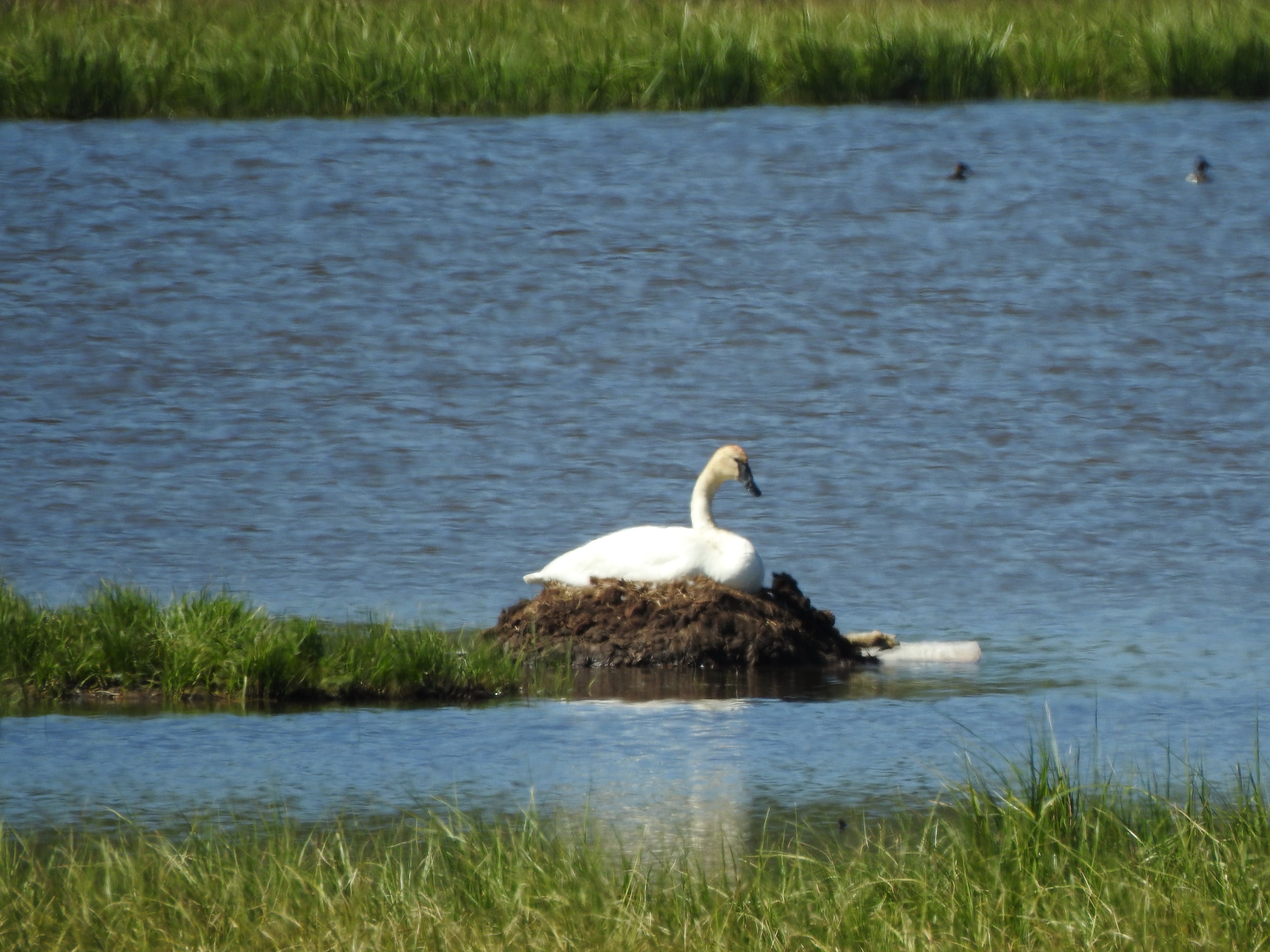
  1. Trumpeter Swan
  2. Vesper Sparrow
  3. Peregrine Falcon
  4. Common Nighthawk
  5. Swainson's Hawk
  6. Ferruginous Hawk
  7. Loggerhead Shrike
  8. Chestnut-collared Longspur
  9. Lark Bunting
  10. Warbling Vireo
  11. Virginia's Warbler

Trumpeter Swan

Lark Bunting

Swainson's Hawk

Ferruginous Hawk

Chestnut-collared Longspur

Common Nighthawk


Friday, June 13, 2025

Storming the Desert for a Reunion Tour

Photo credit: Paul Sheppard

Spring is a very special time of year for anyone who has an interest in birds. As the season draws near a certain anticipation creeps into your consciousness. You know that very soon birds will once again be on the move towards their breeding grounds. Around home you check your gear, clean and re-hang the feeders hoping the Orioles arrive soon, and you start planning.

Last season Michael Morris and I were lucky enough to be at Butterbredt Spring on the northern edge of the Mojave Desert on a peak migration day. Wave upon wave of migrating birds came over the spring and headed north up the canyon. It was a spectacular morning (you can read about that trip HERE). This year we wanted to go back for another bite at the apple as part of a broader Southern California Spring Desert tour. The plan was made, the supplies were purchased and the date was set. Michael and I would pick up Jeff in Alameda and we would head for Kern County with the goal of reaching 200 species for the trip. However, the best part of our plan was that halfway through the trip we would be joined by our good friend Paul Sheppard from Tucson, Az.

Paul was the founder and leading force of The Ol' College Try, our college barbershop quartet and an organizer of our earlier birding trips together in our post university days. Over the years we've stayed in touch and managed to periodically get together for a birding trip/reunion of sorts. Paul enjoys making videos and he has created a nice retrospective of these adventures HERE.

Our birding began shortly after picking up Jeff in Alameda where we were able to start our trip list with the usual species found along the shores of the island. The highlight was four species of Tern: Least, Elegant, Caspian, and Forster's. We then headed south down the I-5 corridor for the traditional stop at Kern National Wildlife Refuge. Birds of note here were the trip's only Yellow-headed Blackbirds, all the expected ducks including Blue-winged Teal, and really nice Clark's Grebe. Then on our way through Bakersfield we made several stops looking for the Rose-ringed Parakeets that can be found there finally seeing a group of them at Beale Park. That is one more on the life list for Michael. We would once again stay that night with my mother-in-law Shirlene who is always a gracious host to "the bird nerds."


Below Butterbredt Spring

We would leave Bakersfield very early the next morning to be at Butterbredt Spring by sunrise.  While our two mornings at Butterbredt did not produce the spectacular waves of migrants that we had last year, we did enjoy the spectacle of migration as birds were definitely moving through the canyon and spring on their way north. We had a fair number of Western Tanagers as well as Costa's Hummingbird, MacGillivray's Warbler, Lazuli Bunting, and Scott's Oriole to name a few. We then made our way up through Butterbredt Canyon, over the pass and down into Kelso Valley eventually coming out to Hwy. 178 at the Audubon Kern River Preserve. Interesting additions to our bird list along this stretch were: Willow Flycatcher, Woodhouse's Scrub Jay, Cassin's Vireo, and California Thrasher. We were unable to enter the Preserve which was not surprising for this time of year as the South Fork of the Kern River, carrying snow melt from the southern Sierra, cuts off the access road. This is an important preserve for the Yellow-billed Cuckoo which nests within its boundaries.  I have heard them here in  summer and hope to visit again at this time of year to see them once again. We were able to add Tri-colored Blackbird to our trip list here as there is a local population in the fields around the preserve. We then made an obligatory stop at "Migrant Corner" on Sierra Rd. and added Wood Duck and Barn Owl to the list.

From here we went east on 178 to check out another location that I had only just learned about, Canebreak Ecological Preserve, an interesting spot where the Kern River exits the mountains and turns westward into the Kern River Valley before flowing into Lake Isabella. By this time it was close to the middle of the day and not the best time for birding. We walked the trail, adding a few more species to the list, but perhaps the coolest part of this stop was the snowstorm of cottonwood seeds that surrounded us on our walk down the trail.

The next phase of this very interesting birding day was a drive up into the Owens Peak Wilderness on Chimney Peak Rd. This road climbs steeply up into the mountains and then travels north to intersect with Sherman Pass Rd. We decided to drive the entire road if we could and it proved to be quite easy. We enjoyed a nice lunch stop at Chimney Creek Campground about halfway along the route. Birds of note for this part of the day were Mountain Quail, Black-throated Gray Warbler, Olive-sided Flycatcher,  and Mountain Bluebird.


Along Sherman Pass Rd. (Jeff Manker)

We came back around via Walker Pass and made our way back to Butterbredt Spring to camp for the night. On our way back along Kelso Valley Road we stopped at another desert migrant trap called Frog Spring which proved to be very productive especially for warblers. Here we counted six different species: Yellow, Wilson's, Yellow-rumped, Nashville, Townsend's, and Orange Crowned. Although not a large area, it's blend of Cottonwoods, Willows and a 2,000 sq. ft. pond formed from the spring make this a top notch habitat for migrating birds.


Butterbredt Spring (Jeff Manker)

We had one more morning at Butterbredt Spring before transfering from the northern to the southern Mojave and Joshua Tree National Park. Along the way we stopped at the Park in California City and picked up Neotropic Cormorant and a really nice Cooper's Hawk and at Mojave Narrows County Park where we added Vermillion Flycatcher and Black-chinned Hummingbird. Our accomodation in Joshua Tree for the next three nights had a nice patch of desert behind it that brought a group of Verdins in close. Other neighborhood birds were Lazuli Bunting, Hooded Oriole, and a pair of Great Horned Owls that emerged from the trees in the evening.


Big Morongo Canyon (Jeff Manker)

Hiking down Big Morongo Canyon (Jeff Manker)


Over the course of the next two days Paul would join us from Tucson and we would bird Big Morongo Canyon Preserve, Whitewater Preserve and several other local spots. One of the other spots that proved to be most interesting was Knott Sky Park in Twentynine Palms. We went there because of an ebird report of a Summer Tanager which we didn't see there but we found a bunch of other stuff including Gray Flycatcher, Cactus Wren, a variety of warblers, Chipping Sparrows, Black-headed Grosbeaks, Red-naped Sapsucker, and a hungry Sharp-shinned Hawk on the prowl. We returned in the evening expecting the lights to be on at the softball fields (a great way to see nighthawks) but they were not. There were parking lot lights though and many bats were flying around and eventually two Lesser Nighthawks made an appearance to add to our list.


Summer Tanager at Big Morongo Canyon Preserve


Big Morongo Canyon Preserve is another great spot for birds. Another place in the desert where water comes to the surface and creates an ideal spot for both resident and migrating species. Over the years they have done an excellent job of constructing trails and boardwalks in the preserve and they have a nature center with many types of feeders set up that always puts on a good show. We made several visits to the preserve while in the area, one of which involved hiking the length of Big Morongo Canyon from top to bottom. Some of our highlights were Summer Tanager, Black-tailed Gnatcatcher, White-winged Dove, Brown-crested Flycatcher, Bell's Vireo, and Yellow-breasted Chat.


Sunset over Joshua Tree

Our final night in Joshua Tree brought us an incredible sunset as well as time plenty of time to sing and reminisce about the past (see Paul's video for details). The next morning we were off early to bird the eastern shore of the Salton Sea. Jeff and I had been there a few years ago for our "Jet-set birding adventure" which I wrote about HERE. Michael and Paul had not been back since our original 1986 trip when we camped on Carcass Beach amongst the carcasses. The east shore was surprisingly quiet as we headed south. We did pick up Wilson's Phalarope and Vaux's Swift at the State Recreation Area. Things began to pick up when we left the main road at the Wister Unit of the Wildlife Refuge. We were hoping to find a Yellow-footed Gull but all of our candidates proved to be too far off for identifiable viewing. We did well with Terns however. Gull-billed, Least and Forester's all made appearances, the Gull-billed being a lifer for Jeff. We also found Common Gallinule, American White Pelican and Burrowing Owl on our way to the Refuge Headquarters where we also added Abert's Towhee and Common Ground Dove. Leaving the Headquarters it was a short jump over to Carcass Beach where we had our most productive encounter with the Sea. This of course was the place we had camped on our way back into California back in 1986. Arriving there very late at night and throwing out our sleeping bags to wake up the next morning surrounded by dead fish, something Paul's wife Irene will never let us forget. Here we found quite a few Snowy Plovers, Least Sandpipers, Red-necked Phalarope, Red Knot, Willet and Bonaparte's Gull.


Carcass Beach at the Salton Sea (Jeff Manker)


As the afternoon progressed the wind began to rise in the Imperial Valley sending quite a bit of dust into the air. Our guidebook told us that there was the chance of a Gila Woodpecker in a park in Brawley and since we were on a mission to get to 200 species on this trip, every bird counted. We went for it and to our surprise found a nesting pair pretty easily. From here we headed back north to check out an oasis called Dos Palmas Preserve. It turns out that the San Andreas Fault runs right under it and is responsible for bringing water to the surface in a very dry area. This oasis was pretty spectacular, so densely packed with palms it was hard to find the water but it was there. Walking along the barely discernable path, one of us said it was like being on a Disney movie set. There were many Orioles and Grosbeaks but the best moment was when I looked up and said, "That looks strange," and Michael looking over his shoulder at what he thought was just a Turkey Vulture jokingly said, "Probably a Zone-tailed Hawk." Well, I took a moment to look a little more closely and sure enough it was a Zone-tailed Hawk. We had seen plenty of these in Arizona but this was the first time any of us ever saw one in California. This was probably the best surprise sighting of the trip.


Zone-tailed Hawk (Jeff Manker)


The rest of our day involved getting ourselves to Corn Spring Campground in the new Chuckwalla National Monument. Google maps said this would take us about and hour and a half but as Paul said, "Chuck knew a short-cut that would take at least twice as long so we took that." In my defense I had contacted the local BLM office about the road and was told it was doable even with 2-wheel drive.  This turned out not to be the case. Summit Road definitely required 4-wheel drive and it was a little rough at times but we eventually made it out to Interstate 10 where we took a brief dinner break. We rolled into Corn Spring Campground after dark and it wasn't long before we were all in the sack under the stars.


Dinner beside I-10 (Paul Sheppard)


Corn Spring in Chuckwalla National Monument


Petroglyphs at Corn Spring


The next day we had an enjoyable morning birding the area around the campground and checking out the petroglyphs there, some of which date back as far as 10,000 years. They are said to be one of the finest examples of rock art in the Colorado desert. We did not add any new species to our trip list here and we were beginning to think we might not make it to 200 by the end. When we returned to the interstate it was time to break our fellowship, Paul headed east back to Tucson and summer field camp for his dendro class. Michael, Jeff, and I took the road through Joshua Tree National Park where we finally managed to nab a Canyon Wren before heading back north across the Mojave where we planned to camp on Greenhorn Summit near Lake Isabella.  Acting on some intelligence we gleaned from ebird, we made a stop at Silver Lakes in San Bernardino County. This is another of those desert communities centered around artificial lakes. I suppose that they make desert living more comfortable but I wonder at the sense of this when water is such a scarce commodity. Anyway, it does attract birds and we added Red-breasted Merganser, Lesser Scaup, Franklin's Gull, Common Loon and Yellow-rumped Warbler to the list.

The drive north on Hwy. 395 was very scenic and pleasant, we joined 178 and went over Walker Pass for the second time on this trip and headed for Kernville for dinner in the pub there. We planned to camp at Greenhorn Park but Kern County had not opened it for the season yet so we ended up back down on the shores of the lake. We did have a very cool bird encounter near Alta Sierra as we were looking for somewhere to camp. Rounding a bend in the road we picked up the eye-shine of a Common Poorwill in the road. We were able to watch it for a minute or two before it moved into the trees and then again on our way back down. We hear this bird often but rarely see it so it was a treat for all of us.

We began the next morning at 187 species and we hoped that the montaine area around Greenhorn Summit would turn up 13 new birds before we left the mountains. Here is what we found up there: Dusky Flycatcher, Steller's Jay, Mountain Chickadee, Red-breasted Nuthatch, Brown Creeper, Townsend's Solitaire, Purple Finch, Fox Sparrow, Dark-eyed Junco, Hermit Warbler, Band-tailed Pigeon, and Hammond's Flycatcher. We were one short of our goal. We descended out of the mountains on Hwy. 155 hoping to pick up one more bird before declaring our trip over. This was another California road that I had not traveled on before and although it was pretty twisty it was quite scenic. As we left the mountains and entered the foothills we were saved by the noblest of birds (according to Benjamin Franklin that is) the Turkey. Crossing the road right in front of us, we hit species number 200.

Once again we had a great trip. It is always a highlight for me to take trips with these characters. The bonds we forge in college are the type that prove to be resistant to the forces of time. When we get together, barring appearances, not much seems to have changed. Paul says he's going to retire soon so maybe he'll be able to join us more often. As he left he was talking about Florida in 2 years time. I have a lot of birds to add to my list if we go there.

Inside Dos Palmas Preserve (Jeff Manker)


Monday, April 21, 2025

Great Gray Owls in Yosemite National Park

For many people there is one particular bird or bird species that once seen can ignite an interest in birds and birding. In my encounters with other birders out there I often discover that it was the sighting of an owl species that lit the fuse for them.  For my friend Jeff it was the Burrowing Owls that were present in his Southern California neighborhood that really fanned the flames of his passion for birds. For many years now he has been hoping to encounter North America's largest owl species the Great Gray Owl and the month of April is a good time to go looking for them.

In California the Great Gray Owl (GGOW) is an endangered species. Scientists estimate that there are fewer than 100 pairs in the state, 65% of which reside within the boundaries of Yosemite National Park. The California population of these birds is somewhat unique in that researches have shown them to be genetically and behaviorally distinct from the rest of the GGOWs found in North America. This indicates that they have been geographically isolated from the rest of their species for a significant period of time. In 2009, while leading a school group for a week of outdoor ed in the park, I had my one and only encounter with the GGOW. You can see that blog post here. That encounter gave me some insight on when and where to see these birds in the park. April is a good time to look for them for several reasons. As the snow melt is accelerating the mid-elevation meadows become more accessible for hunting owls, the deciduous trees on the meadow edges have not yet begun to leaf out making sightings there easier, and the owls are beginning their mating activities as they move upslope into these meadows for the breeding season.

Knowing that Jeff wanted to make an effort to see these birds I proposed a one-day speed run up to the park to make the attempt. Fortunately, Friday April 18 was free for both of us. We met at 5 am. at the Pleasanton Park-n-Ride and were in place for our attempt by 8 am. Since the park identifies the GGOW as a sensitive species they state on their website that the locations of sightings of these birds should not be publicized and therefore I will not disclose where we saw them. We began our survey by starting in the place where I saw them 16 years ago. Not surprisingly, we did not see them there so we expanded our search to other meadows in the area. At one point, as we were moving through the forest between meadows we heard the characteristic low booming hoot of the GGOW. For the next 30 minutes we tracked it through the forest catching periodic brief glimpses in an increasingly frustrating attempt to get a clear view of it. Eventually our hunt took us to the edge of a large meadow where there in the distance we could see a large owl perched on a branch 10 feet off the ground at the meadow's edge. Although our observation was distant we could clearly see that we had found our elusive GGOW. As we watched this bird we could hear another hooting in the forest near by indicating that there were at least two in the area. Each time the one in the forest hooted we could see the one perched in the tree react to it and eventually it flew off into the forest in the direction of the other bird. We congratulated ourselves on the good fortune of seeing this bird and went to examine the ground below the owl's perch for pellets then sat at the meadow's edge in the hope that we might see the bird again. We gave it a good 20 minutes and decided to head back. As we got up and began to move off I turned and looked over my shoulder and across the meadow to a stand of Birch trees and thought that an excellent place for an owl to perch so I paused and scanned the small grove. I immediately called Jeff back because there, 5 feet off the ground was another GGOW. I think this was a third bird but we could not be certain of that. We were much closer this time and were able to get some good pictures and spend some quality time enjoying this bird.


After this the rest of the day was gravy. We traveled the Hetch Hetchy Rd. out to the dam then followed the Mather Rd. down into the canyon of the Tuolumne River and enjoyed a picnic along the river. We then drove Smith Station Rd. off of Hwy. 120 down to Coulterville an on across Hwy. 132 where we visited San Joaquin River National Wildlife Refuge to end our day. Other notable birds of the day were Nashville Warbler, Black-throated Gray Warbler, Pileated Woodpecker, Mountain Quail, Rock Wren, and Lawrence's Goldfinch.

We had such an amazing day, it is so rewarding to find what you think might be there in the place you think it might be. I stress the word 'might' as there are no guarantees in the world of birding. This is a field trip that I will repeat next year and hopefully for many years to come. Great Gray Owls are truly amazing birds, what a joy to see them again.