Showing posts with label Kern County. Show all posts

Wednesday, May 13, 2026

Vagrants in Spring

Yellow-throated Warbler (image from Public Domain)

Springtime is such a joy to a person interested in birds. The weather is warming, the hills are green and full of spring flowers, and the birds are displaying their showiest plumages. It is also one of the two times of year (spring and fall migration) when you can expect a few birds to show up in your local area that are wildly off course from their normal haunts. These birds are called "vagrants". If you are a birder who is into the chase as I am then you will probably be plugged into the various social media channels that report these wanderers (ebird, list serves, etc.). Last week a report popped up of a Yellow-throated Warbler in San Francisco's Golden Gate Park. One of these had been showing well in Humboldt County but I couldn't make an escape to go see that one so this was my chance. I was in the truck 15 minutes after seeing the message and pulled up to the hotspot after a 1-hour drive. Another birder was there and as I walked up to her I asked if she had seen it. She said she could hear it high in the Eucalyptus trees and as I got close to her I saw some movement behind her about 1/2 way up the understory and there it was, a beautiful bright male. We followed it's movement for about 30 minutes, helping other birders locate it as they arrived. Conditions were very poor for photography so I will have no photo documentation of this sighting but that's not so important. This eastern warbler has eluded me on it's home territory so it was a special sighting to see it here in California.

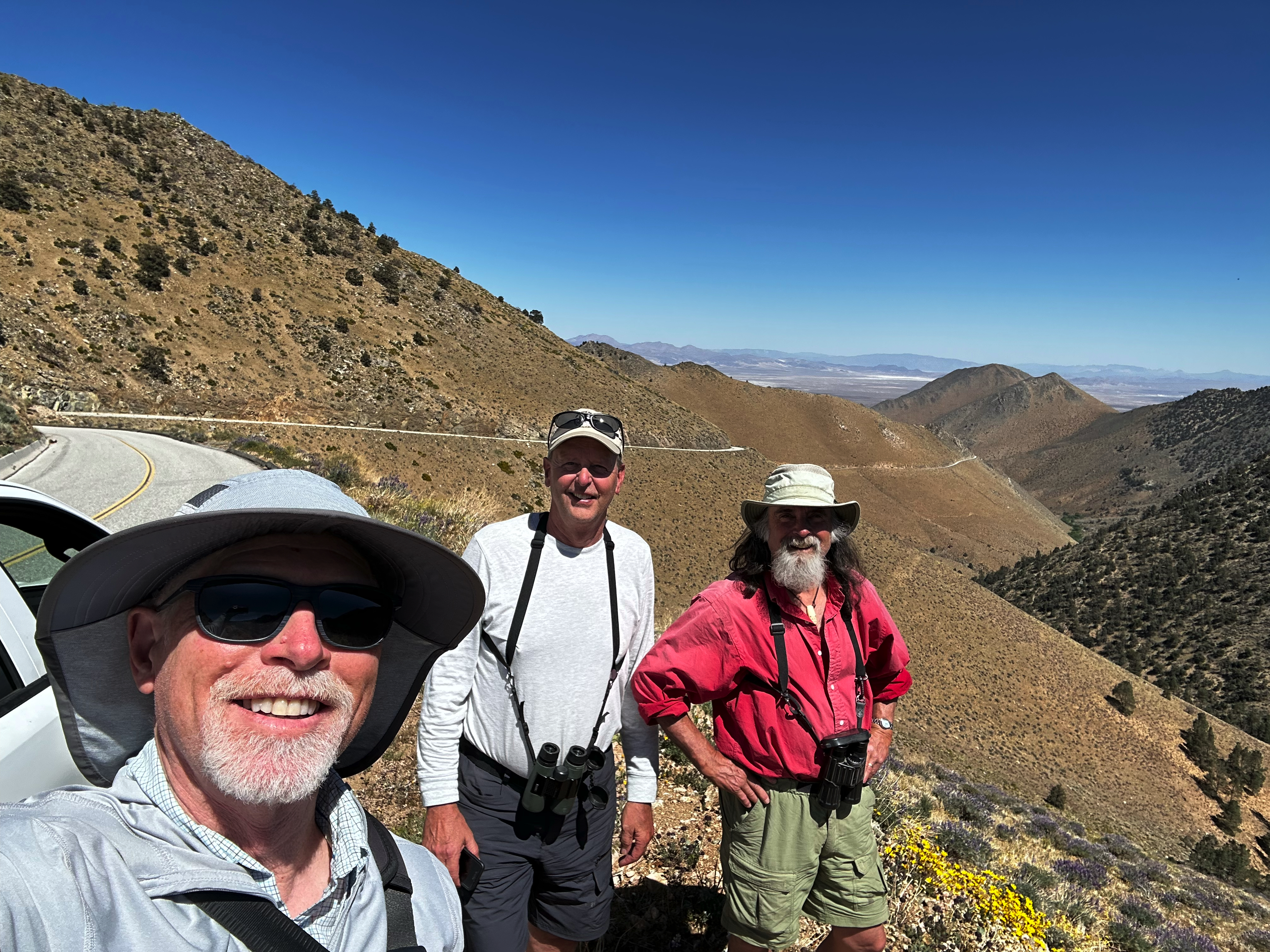
Another springtime birding tradition I have maintained is a visit to Butterbredt Spring on the northern edge of the Mojave Desert. I had not made any birding plans for May as we had expected to be traveling but circumstances arose that required us to postpone that trip and now I had some time on my hands. My two regular companions for these trips, Michael and Jeff were busy with other things so I would make this trip on my own (however, I sorely missed their company).

I took a somewhat circuitous route going south driving out Mines Rd. from Livermore and then out to I-5 via Del Puerto Canyon Rd. This took me through some really beautiful country, all the while I was wishing I could be doing it on my bike! Plenty of Oak Titmouse, Black-headed Grosbeak, Yellow-billed Magpie and Acorn Woodpeckers but curiously absent of warbler species (granted I only stopped a few times as I had a long way to go). Then it was on to Kern National Wildlife Refuge where I drove the tour route and saw most of the usual suspects for this time of year. Of note were the large number of Cattle Egrets and a nesting pair of Common Gallinules. Quite a few Yellow and Wilson's Warblers as well.

Heading towards the Mojave I drove around Lake Isabella to Weldon and then south towards Butterbredt. I stopped briefly at Frog Springs to see if any migration wave had come over the ridge that day, my conclusion - no. Not many birds here. As I reached the intersection of Jawbone Canyon Rd. and Butterbredt Canyon Rd. I was greeted by a rather large rattlesnake guarding the entrance. I deftly navigated around him and made my way over the pass and on down to the spring. Not a lot of diversity in the migrants over the pass, mostly Western Tanagers. There was a pretty strong north wind blowing when I got to the spring and there were many warblers and tanagers in the Trees of Heaven seemingly waiting for things to calm down.  That evening and the next morning there was a significant wave of migrants coming up the canyon, stopping at the spring and then passing on. Warblers were Yellow, Yellow-rumped, Wilson's, Townsend's, Orange-crowned and a few Nashville. I was very surprised by a female Northern Parula, a bird I had never seen at Butterbredt before. As I walked down the canyon below the spring, migrating birds continued to pass for the rest of the morning. I photographed what I thought was a funny looking Wilson's Warbler but what turned out to be a female Hooded Warbler, another bird I had never seen at Butterbredt before. Later that day I met a Las Vegas birder named John Mark Simmons who said he had seen both of the rare warblers down in the spring as he sat by the water. He was kind enough to point out the differences between a female Hooded and a Wilson's, namely the white outer tail feathers. I went down into the spring and sat for a bit fighting off the mosquitos and was visited by both again. What a treat!

As is often the case in a migrant trap like Butterbredt Spring the next morning was pretty quiet. I had arrived as a wave was passing through and it was gone the next day. There were still a few good birds around. Loggerheaded Shrike, Cassin's Vireo, both Dusky and Hammond's Flycatchers, Ash-throated Flycatchers and several Costa's Hummingbirds. All in all another great visit to a special place. Returning to Bakersfield,  I took the long way and drove over Breckenridge Road. All the way over from the east side there were singing Lazuli Buntings and as I reached the forest on the top I wished I had more time to explore. It was beautiful up there. I finished up my trip with a stop for lunch and a quick visit with my mother-in-law and then back to Napa to wait for the next adventure.

See my trip list here.  Some photos from my adventure:


Hooded Warbler


Northern Parula


Western Cattle Egret


The Guardian of Butterbredt Canyon


Western Tanager


Lazuli Bunting


Great Horned Owl (hatch year)


Ash-throated Flycatcher


Yellow Warbler


Wilson's Warbler


Costa's Hummingbird


Bullock's Oriole

Friday, June 13, 2025

Storming the Desert for a Reunion Tour

Photo credit: Paul Sheppard

Spring is a very special time of year for anyone who has an interest in birds. As the season draws near a certain anticipation creeps into your consciousness. You know that very soon birds will once again be on the move towards their breeding grounds. Around home you check your gear, clean and re-hang the feeders hoping the Orioles arrive soon, and you start planning.

Last season Michael Morris and I were lucky enough to be at Butterbredt Spring on the northern edge of the Mojave Desert on a peak migration day. Wave upon wave of migrating birds came over the spring and headed north up the canyon. It was a spectacular morning (you can read about that trip HERE). This year we wanted to go back for another bite at the apple as part of a broader Southern California Spring Desert tour. The plan was made, the supplies were purchased and the date was set. Michael and I would pick up Jeff in Alameda and we would head for Kern County with the goal of reaching 200 species for the trip. However, the best part of our plan was that halfway through the trip we would be joined by our good friend Paul Sheppard from Tucson, Az.

Paul was the founder and leading force of The Ol' College Try, our college barbershop quartet and an organizer of our earlier birding trips together in our post university days. Over the years we've stayed in touch and managed to periodically get together for a birding trip/reunion of sorts. Paul enjoys making videos and he has created a nice retrospective of these adventures HERE.

Our birding began shortly after picking up Jeff in Alameda where we were able to start our trip list with the usual species found along the shores of the island. The highlight was four species of Tern: Least, Elegant, Caspian, and Forster's. We then headed south down the I-5 corridor for the traditional stop at Kern National Wildlife Refuge. Birds of note here were the trip's only Yellow-headed Blackbirds, all the expected ducks including Blue-winged Teal, and really nice Clark's Grebe. Then on our way through Bakersfield we made several stops looking for the Rose-ringed Parakeets that can be found there finally seeing a group of them at Beale Park. That is one more on the life list for Michael. We would once again stay that night with my mother-in-law Shirlene who is always a gracious host to "the bird nerds."


Below Butterbredt Spring

We would leave Bakersfield very early the next morning to be at Butterbredt Spring by sunrise.  While our two mornings at Butterbredt did not produce the spectacular waves of migrants that we had last year, we did enjoy the spectacle of migration as birds were definitely moving through the canyon and spring on their way north. We had a fair number of Western Tanagers as well as Costa's Hummingbird, MacGillivray's Warbler, Lazuli Bunting, and Scott's Oriole to name a few. We then made our way up through Butterbredt Canyon, over the pass and down into Kelso Valley eventually coming out to Hwy. 178 at the Audubon Kern River Preserve. Interesting additions to our bird list along this stretch were: Willow Flycatcher, Woodhouse's Scrub Jay, Cassin's Vireo, and California Thrasher. We were unable to enter the Preserve which was not surprising for this time of year as the South Fork of the Kern River, carrying snow melt from the southern Sierra, cuts off the access road. This is an important preserve for the Yellow-billed Cuckoo which nests within its boundaries.  I have heard them here in  summer and hope to visit again at this time of year to see them once again. We were able to add Tri-colored Blackbird to our trip list here as there is a local population in the fields around the preserve. We then made an obligatory stop at "Migrant Corner" on Sierra Rd. and added Wood Duck and Barn Owl to the list.

From here we went east on 178 to check out another location that I had only just learned about, Canebreak Ecological Preserve, an interesting spot where the Kern River exits the mountains and turns westward into the Kern River Valley before flowing into Lake Isabella. By this time it was close to the middle of the day and not the best time for birding. We walked the trail, adding a few more species to the list, but perhaps the coolest part of this stop was the snowstorm of cottonwood seeds that surrounded us on our walk down the trail.

The next phase of this very interesting birding day was a drive up into the Owens Peak Wilderness on Chimney Peak Rd. This road climbs steeply up into the mountains and then travels north to intersect with Sherman Pass Rd. We decided to drive the entire road if we could and it proved to be quite easy. We enjoyed a nice lunch stop at Chimney Creek Campground about halfway along the route. Birds of note for this part of the day were Mountain Quail, Black-throated Gray Warbler, Olive-sided Flycatcher,  and Mountain Bluebird.


Along Sherman Pass Rd. (Jeff Manker)

We came back around via Walker Pass and made our way back to Butterbredt Spring to camp for the night. On our way back along Kelso Valley Road we stopped at another desert migrant trap called Frog Spring which proved to be very productive especially for warblers. Here we counted six different species: Yellow, Wilson's, Yellow-rumped, Nashville, Townsend's, and Orange Crowned. Although not a large area, it's blend of Cottonwoods, Willows and a 2,000 sq. ft. pond formed from the spring make this a top notch habitat for migrating birds.


Butterbredt Spring (Jeff Manker)

We had one more morning at Butterbredt Spring before transfering from the northern to the southern Mojave and Joshua Tree National Park. Along the way we stopped at the Park in California City and picked up Neotropic Cormorant and a really nice Cooper's Hawk and at Mojave Narrows County Park where we added Vermillion Flycatcher and Black-chinned Hummingbird. Our accomodation in Joshua Tree for the next three nights had a nice patch of desert behind it that brought a group of Verdins in close. Other neighborhood birds were Lazuli Bunting, Hooded Oriole, and a pair of Great Horned Owls that emerged from the trees in the evening.


Big Morongo Canyon (Jeff Manker)

Hiking down Big Morongo Canyon (Jeff Manker)


Over the course of the next two days Paul would join us from Tucson and we would bird Big Morongo Canyon Preserve, Whitewater Preserve and several other local spots. One of the other spots that proved to be most interesting was Knott Sky Park in Twentynine Palms. We went there because of an ebird report of a Summer Tanager which we didn't see there but we found a bunch of other stuff including Gray Flycatcher, Cactus Wren, a variety of warblers, Chipping Sparrows, Black-headed Grosbeaks, Red-naped Sapsucker, and a hungry Sharp-shinned Hawk on the prowl. We returned in the evening expecting the lights to be on at the softball fields (a great way to see nighthawks) but they were not. There were parking lot lights though and many bats were flying around and eventually two Lesser Nighthawks made an appearance to add to our list.


Summer Tanager at Big Morongo Canyon Preserve


Big Morongo Canyon Preserve is another great spot for birds. Another place in the desert where water comes to the surface and creates an ideal spot for both resident and migrating species. Over the years they have done an excellent job of constructing trails and boardwalks in the preserve and they have a nature center with many types of feeders set up that always puts on a good show. We made several visits to the preserve while in the area, one of which involved hiking the length of Big Morongo Canyon from top to bottom. Some of our highlights were Summer Tanager, Black-tailed Gnatcatcher, White-winged Dove, Brown-crested Flycatcher, Bell's Vireo, and Yellow-breasted Chat.


Sunset over Joshua Tree

Our final night in Joshua Tree brought us an incredible sunset as well as time plenty of time to sing and reminisce about the past (see Paul's video for details). The next morning we were off early to bird the eastern shore of the Salton Sea. Jeff and I had been there a few years ago for our "Jet-set birding adventure" which I wrote about HERE. Michael and Paul had not been back since our original 1986 trip when we camped on Carcass Beach amongst the carcasses. The east shore was surprisingly quiet as we headed south. We did pick up Wilson's Phalarope and Vaux's Swift at the State Recreation Area. Things began to pick up when we left the main road at the Wister Unit of the Wildlife Refuge. We were hoping to find a Yellow-footed Gull but all of our candidates proved to be too far off for identifiable viewing. We did well with Terns however. Gull-billed, Least and Forester's all made appearances, the Gull-billed being a lifer for Jeff. We also found Common Gallinule, American White Pelican and Burrowing Owl on our way to the Refuge Headquarters where we also added Abert's Towhee and Common Ground Dove. Leaving the Headquarters it was a short jump over to Carcass Beach where we had our most productive encounter with the Sea. This of course was the place we had camped on our way back into California back in 1986. Arriving there very late at night and throwing out our sleeping bags to wake up the next morning surrounded by dead fish, something Paul's wife Irene will never let us forget. Here we found quite a few Snowy Plovers, Least Sandpipers, Red-necked Phalarope, Red Knot, Willet and Bonaparte's Gull.


Carcass Beach at the Salton Sea (Jeff Manker)


As the afternoon progressed the wind began to rise in the Imperial Valley sending quite a bit of dust into the air. Our guidebook told us that there was the chance of a Gila Woodpecker in a park in Brawley and since we were on a mission to get to 200 species on this trip, every bird counted. We went for it and to our surprise found a nesting pair pretty easily. From here we headed back north to check out an oasis called Dos Palmas Preserve. It turns out that the San Andreas Fault runs right under it and is responsible for bringing water to the surface in a very dry area. This oasis was pretty spectacular, so densely packed with palms it was hard to find the water but it was there. Walking along the barely discernable path, one of us said it was like being on a Disney movie set. There were many Orioles and Grosbeaks but the best moment was when I looked up and said, "That looks strange," and Michael looking over his shoulder at what he thought was just a Turkey Vulture jokingly said, "Probably a Zone-tailed Hawk." Well, I took a moment to look a little more closely and sure enough it was a Zone-tailed Hawk. We had seen plenty of these in Arizona but this was the first time any of us ever saw one in California. This was probably the best surprise sighting of the trip.


Zone-tailed Hawk (Jeff Manker)


The rest of our day involved getting ourselves to Corn Spring Campground in the new Chuckwalla National Monument. Google maps said this would take us about and hour and a half but as Paul said, "Chuck knew a short-cut that would take at least twice as long so we took that." In my defense I had contacted the local BLM office about the road and was told it was doable even with 2-wheel drive.  This turned out not to be the case. Summit Road definitely required 4-wheel drive and it was a little rough at times but we eventually made it out to Interstate 10 where we took a brief dinner break. We rolled into Corn Spring Campground after dark and it wasn't long before we were all in the sack under the stars.


Dinner beside I-10 (Paul Sheppard)


Corn Spring in Chuckwalla National Monument


Petroglyphs at Corn Spring


The next day we had an enjoyable morning birding the area around the campground and checking out the petroglyphs there, some of which date back as far as 10,000 years. They are said to be one of the finest examples of rock art in the Colorado desert. We did not add any new species to our trip list here and we were beginning to think we might not make it to 200 by the end. When we returned to the interstate it was time to break our fellowship, Paul headed east back to Tucson and summer field camp for his dendro class. Michael, Jeff, and I took the road through Joshua Tree National Park where we finally managed to nab a Canyon Wren before heading back north across the Mojave where we planned to camp on Greenhorn Summit near Lake Isabella.  Acting on some intelligence we gleaned from ebird, we made a stop at Silver Lakes in San Bernardino County. This is another of those desert communities centered around artificial lakes. I suppose that they make desert living more comfortable but I wonder at the sense of this when water is such a scarce commodity. Anyway, it does attract birds and we added Red-breasted Merganser, Lesser Scaup, Franklin's Gull, Common Loon and Yellow-rumped Warbler to the list.

The drive north on Hwy. 395 was very scenic and pleasant, we joined 178 and went over Walker Pass for the second time on this trip and headed for Kernville for dinner in the pub there. We planned to camp at Greenhorn Park but Kern County had not opened it for the season yet so we ended up back down on the shores of the lake. We did have a very cool bird encounter near Alta Sierra as we were looking for somewhere to camp. Rounding a bend in the road we picked up the eye-shine of a Common Poorwill in the road. We were able to watch it for a minute or two before it moved into the trees and then again on our way back down. We hear this bird often but rarely see it so it was a treat for all of us.

We began the next morning at 187 species and we hoped that the montaine area around Greenhorn Summit would turn up 13 new birds before we left the mountains. Here is what we found up there: Dusky Flycatcher, Steller's Jay, Mountain Chickadee, Red-breasted Nuthatch, Brown Creeper, Townsend's Solitaire, Purple Finch, Fox Sparrow, Dark-eyed Junco, Hermit Warbler, Band-tailed Pigeon, and Hammond's Flycatcher. We were one short of our goal. We descended out of the mountains on Hwy. 155 hoping to pick up one more bird before declaring our trip over. This was another California road that I had not traveled on before and although it was pretty twisty it was quite scenic. As we left the mountains and entered the foothills we were saved by the noblest of birds (according to Benjamin Franklin that is) the Turkey. Crossing the road right in front of us, we hit species number 200.

Once again we had a great trip. It is always a highlight for me to take trips with these characters. The bonds we forge in college are the type that prove to be resistant to the forces of time. When we get together, barring appearances, not much seems to have changed. Paul says he's going to retire soon so maybe he'll be able to join us more often. As he left he was talking about Florida in 2 years time. I have a lot of birds to add to my list if we go there.

Inside Dos Palmas Preserve (Jeff Manker)


Monday, May 20, 2024

Butterbredt, Owens Valley and Sierra Valley - A Migration Bonanza

Upper Butterbredt Canyon

During the second week of May I made my annual pilgrimage to the Mojave Desert. I was fortunate to be joined this year by my good friend Michael Morris who came down from Eureka for the trip. Although we ended up doing a lot of driving we did have an amazing trip seeing 164 species over our 4 days.

        See our complete bird list                                                See our photos from this trip

After leaving Napa we headed straight for Kern County and the Kern National Wildlife Refuge where we started our trip list, a list that would grow to 94 species by the end of the day. After a few hours of birding the tour route at the refuge and picking up what we would normally expect to see there, we headed east through Bakersfield and on into the Kern River canyon. Our plan was to travel along the river up the canyon to Lake Isabella then in Weldon take Kelso Valley Rd. and then Butterbredt Canyon Rd. over the pass and down to Butterbredt Spring. As we drove over Butterbredt Pass and then down to the spring we added a lot of species that were using the migration corridor of Butterbredt Canyon. We camped at the spring that night and woke up to wave after wave of migrants coming up the canyon. In all my years of coming to Butterbredt, this was by far the most impressive bird display I have ever seen here. While we didn't see any rarities, it was the sheer number of migrants that was notable. Warblers in the spring and down the canyon and other passerines in the grove of Trees of Heaven just to the north of the spring. Nature is amazing!

After an incredible morning at Butterbredt we began our journey up the Owens Valley. As we made our way north we checked out Sage Flat, the Owens River and then headed east on Hwy. 168 to climb our way up into the White Mountains. We were able to go all the way up to the Ancient Bristlecone Pine Forest visitor's center at Schulman Grove although it was not yet open for the season. We added a few high mountain birds to our list here and then retreated back down to 9,000 ft. and the Grandview campground for the night.

Sierra Crest from the White Mtns.

The next day saw us returning to the Owens Valley where we made several more stops in the morning before turning back towards the White Mountains to drive into Silver Canyon. This four-wheel drive road climbs all the way up to the plateau at the top but it is very steep and rough in places. We only went a little ways up this canyon, far enough to add a few more species to our list, namely Chuckars which gave us great looks along the road.


From here we continued north to Benton Hot Springs and then using Benton Crossing Road and Owens River Rd. made our way back to Hwy. 395 so we could drive the June Lakes Loop. By late afternoon we found ourselves at Mono Lake County Park which is usually pretty birdy. However, we found that as we had moved north the numbers of migrant species we were seeing really began to decline. It was clear that the waves of migrants we were seeing down in the Mojave had not gotten this far north. We did however add a number of resident species to our list as we moved north. 

Our plan that night was to camp at a Forest Service campground just in Nevada along Desert Creek. However, the combination of a navigation error and a very rough road forced us to change our plan and that night we ended up camping along the West Walker River on Hwy 108. We continued to add birds to our trip list the next morning around the campground and then at the Two Rivers Preserve just down the road. From here we decided to finish our trip by driving north through Reno and then visit Sierra Valley before crossing back over the Sierra at Yuba Pass. 

Michael along the West Walker River.

On our way north we detoured just outside the town of Walker and drove a forest road up to the headwaters of Mill Creek. This took us up a beautiful little valley that was dotted with Beaver ponds. I'd not been up this road before and it was well worth the trip. We found our Clark's Nutcracker and White-headed Woodpecker along this route.

Later that day we arrived in Sierra Valley. This large and wet valley sits just on the east side of the Sierra crest and has always impressed me as yet another example of the diversity of the natural wonders California offers us. Here we picked up our last two birds of the trip, Sandhill Cranes and a Willet. Then it was over the pass and down to Downieville for a dinner stop and on back to Napa.

I had a great time traveling and birding with Michael again, although next time I think I will try and cut down on the number of miles we drive in the pursuit of our feathered friends.

Tuesday, April 18, 2023

The Last Thrasher

Worldwide there are 34 species of the family of birds known as Thrashers. Twelve of these species can be found in North America and if you want to see them you need to visit the southwest. Most have rather long decurved bills and all are notable singers and some are capable of mimicry. Probably the best known member of this family is the Mockingbird. Over the years of my birding career I have seen all but one of this family's North American contingent. In recent years this last thrasher, Le Conte's, has become a nemesis bird for me.

Monday, January 2, 2023

A Day Out In Kern County To End The Year


I always enjoy visiting my mother-in-law who lives in Bakersfield because it's nice to see her, but also because it gives me a chance to do some birding in Kern County. The area around Bakersfield where she lives gets a bad rap but I find it to be just as beautiful in its own way as other parts of California. It is true that there are times of the year when the heat and the want of much greenery gives it an oppressive and perhaps ugly visage, but for most of the rest of the year it is quite beautiful.

Thursday, August 11, 2022

Spring in the Mojave - April 2022

*I finally got this write-up done!

Every year come spring, there awakens in me the very strong desire to go adventuring in the desert. For me that almost always has meant the Mojave Desert in Southern California. Maybe it is the desire to find some warmth after the winter season, the excitement of a road trip with friends, or perhaps the certain knowledge that migration is beginning and there will be good and sometimes great birds to be seen. Bottle this all together and you create the circumstances that have taken me to the northern edge of the Mojave year after year to begin a springtime journey at Butterbredt Springs.
There is a certain magic about Butterbredt which I can trace back to my first visit there in the early 1990s with Michael Morris. We were on our way to Arizona for a spring trip and Michael had heard about the spring from his local birding community and was told that it was a must-visit spot for any serious birder traveling through this region. We arrived there in the afternoon, not the ideal time of day, but our stroll through the spring and then down the wash was exceptional and was highlighted by a tree full of about 10 Long Eared Owls. That kind of sighting will lend any place a certain magical aura that will stick with you for the rest of your days. Every time I drive the road into Butterbredt there is that anticipation and excitement that is driven by the question, “What are we going to see this time?”

Butterbredt Spring

Once again this year we were a little early for spring migration as the date of my trip was determined not by when the best time to go would be, but by my school district’s determination of when spring break would occur. The good news is that this would be the last time that would happen as this was my last year teaching before retirement. In planning for this trip I plotted out a circular route we could follow that began at Butterbredt and took in two other places I had longed to visit, Big Morongo Canyon Preserve and the Mid Hills Campground region of the Mojave National Preserve. Joining me as he so often has these last few years was Jeff Manker who took time out from planning for his upcoming wedding to get in one last pre-marriage birding trip. Jeff has now moved up to Alameda so that is where we would begin our trip list.
We began with his local patch that includes the shoreline of San Francisco Bay. This is a strategy that is sure to pad any desert trip list. Our highlight here was the large number of Elegant Terns that were roosting on the jetty across the inlet. After this we headed for Bakersfield, picking up roadside sightings of Wild Turkey and Cattle Egret on the way. When traveling this route a stop at Kern National Wildlife Refuge is always a good idea so we made it our lunch stop. We drove the auto tour route and picked up most of our waterfowl species for the trip. I have to say that the NWR system is one of the hidden gems of the American public lands collection. The system is under stress in California due to drought and climate change but it remains critical to the health and survival of many important resident and migratory bird species. One way birders can support this system is to purchase a Duck Stamp each year. Possession of the stamp covers entry into any National Wildlife Refuge that requires a fee and supports the valuable conservation work the Fish and Wildlife service does. You can get more information and purchase your stamp here.
Later that afternoon we arrived in Bakersfield, went to Beale Park to check out the Rose Ringed Parakeets, and stayed once again with my gracious mother-in-law. Then it was up early to head to the Mojave and Butterbredt Spring. As previously mentioned we were too early for the peak of spring migration so our list here was a bit sparse. Our highlight here was what we believed to be a Gray Flycatcher. We puzzled over this id but this was our conclusion after reviewing the guides and studying the pictures. From the northern edge of the Mojave we headed due south and made for Big Morongo Canyon Preserve. On the way we stopped and birded the county park at the Mojave Narrows.

Jeff at the Narrows

This was an interesting place with plenty of water and riparian habitat. It also had a lot of wind which made things challenging. For me the highlight here were Vermillion Flycatchers, beautiful birds that I had not seen in some time. We birded, had lunch and then played a few holes of disc golf - Jeff crushed me.
We got to Morongo Valley, had dinner and then drove up into Joshua Tree National Park for a dusk walkabout. This walk showed us again that we were a little early as it failed to turn up anything other than a few regular residents.
The next day began with our visit to the Big Morongo Canyon Preserve. Situated at the southern edge of the Mojave Desert, the canyon is a transition from the Mojave to the Colorado Desert below and represents one of the largest cottonwood and willow riparian habitats in California.

Trail heading south from the Preserve into the Canyon

It is a birder’s delight with trails and boardwalks snaking through the preserve. We had been concerned by the winds but fortunately for us our morning visit came before the wind rose. Highlights included: Plumbeous Vireo, Verdin, Costa’s Hummingbird, White-winged Dove, Nashville Warbler, Bell’s Vireo, Vermillion Flycatcher, and Phainopepla. Next time I visit here I hope to hike the entire canyon from top to bottom. As we ate lunch in the parking lot we considered our options. Our plan had been to head back north to the eastern region of the Mojave however the weather forecast was not favorable predicting high winds and cold temperatures at night. With that in mind we opted for a dash to the south and Anza Borrego State Park. This drive took us south through Palm Springs where we made a stop at an e-bird location for an Abert’s Towhee that we didn’t see; however, this proved to be a very interesting stop. We were on the western side of Palm Springs on the slope above town leading towards the tramway and looking into a fenced-off undeveloped property on the edge of a pretty high-class neighborhood. There were lots of Western Kingbirds, a Hooded Oriole, and a Roadrunner walking across the street but probably the most unusual sighting was the 50+ Great and Snowy Egrets roosting in the desert scrub on the hillside. Very strange.
Heading further south we made for Borrego Springs and a stop for the night. On the way we picked up a nice roadside Prairie Falcon and then took a side trip to Clark Dry Lakebed to see the nesting Bendire’s Thrasher that had been reported there throughout the spring.

Prairie Falcon

That evening after dinner we noticed that there was a lighted ballfield on the edge of town and theorized that there may be Nighthawks working the area. We only had to spend about 5 minutes waiting until one flew over the field.
We were up early the next morning and off to Culp Valley Campground in Anza Borrego State Park to go after Jeff’s nemesis bird. For the uninitiated, a nemesis bird is one that everyone else seems to see with little effort but you, for the life of you, can’t seem to get a look at. We’d missed it at Butterbredt Spring and we missed it again here. The bird? - The Mountain Quail. We have heard them calling multiple times and even once later in this trip in Upper Butterbredt Canyon, but no sightings. We had a few good birds here including California Thrashers, another Roadrunner and a Cactus Wren. From here we went to Palm Canyon, a famous palm oasis near the park visitor center. We were last here in the mid 1980s during our first NAS Bird-a-thon. Fire has passed through the canyon several times since that time and the scares are quite evident. However, the oasis is recovering nicely and we had an excellent morning birding this hotspot. We had Costa’s and Anna’s Hummingbirds, a Cooper’s Hawk, Warbling Vireo, Nashville Warbler, Loggerheaded Shrike, Black-throated Sparrow, Black-throated Gray Warbler, Wilson’s Warbler, and Western Tanager to name a few.

Borrego Palm Canyon

After another parking lot lunch we were on the road for the long drive to Mid Hills Campground in the northeastern corner of the Mojave National Preserve. We did take a brief stop at the Joshua Tree NP visitor center where we picked up a Black Tailed Gnatcatcher. Continuing on we made for Mid Hills where there were a few target birds we were hoping to get, namely Gilded Flicker, LeConte’s Thrasher, and Juniper Titmouse. We had also hoped to get a look at a Common Poorwill. It was a mad dash racing the sun and we got to the area only a little before sunset. We walked around the campground and could not add anything to our list except a Northern Flicker.

Looking west from Mid Hills Campground - Mojave National Preserve

Our final day would take us back to Butterbredt and then over the ridge and north to the Kern River Preserve. The Spring gave us very similar results to our visit a few days earlier, not even the usual Chukars made an appearance for us. In leaving Butterbredt we decided we would take the narrow track to the top of the canyon and over into the Kelso Creek drainage. As we neared the pass we picked up a Ladder-backed Woodpecker and a Prairie Falcon but what was most intriguing, the call of the Mountain Quail just up the slope from the road. We beat the bush in hopes of seeing it but alas no, it will remain Jeff’s nemesis. Coming down from the pass through a forest of Joshua trees we heard a call we had not yet heard on this trip and was not familiar to us. We turned to a tool I have been using more of lately to help us with the ID. This is the Merlin bird ID app from Cornell. What I most use it for is its ability to identify a bird by sound. It came back with a result of Scott’s Oriole so we were out of the truck and scanning. Sure enough, working through the top of a Joshua tree about 100 yards away we found him. While Merlin is not 100% accurate it can be a very helpful tool in the process of identification. Feeling very pleased with ourselves we headed down to the Kern River Preserve on the South Fork of the Kern River just upstream from Lake Isabella. This is the first time in several years I have been able to get into the preserve’s headquarters area. Either flooding or the long covid closure have kept me out. We began of course by having lunch and then talked with a volunteer who was doing some clean-up work. It seems that the pandemic has taken a toll on this great preserve and they were just starting to get back on their feet again. The afternoon winds came up and made birding this fabulous riparian habitat a challenge but we walked some of the trails and visited ‘Migrant Corner’ before beginning our return trip to the Bay Area.Over the course of our 5 days of birding we counted a total of 160 different species. Not a bad effort but I can’t wait until next year when we can do this in mid- May. One month later in the year could make a significant difference in our species list. Finally, I get to decide when to go (as long as it's ok with Danette!)

Monday, May 11, 2020

Birding in the Pandemic - My Annual Visit to Butterbredt Spring

Every year as the spring migration approaches I get the itch to travel to places where this spectacle can be enjoyed as well as reveling in the beauty that surrounds me in such places. Last year Jeff Manker and I did a big day during this time and this year we had hoped to repeat the fun and adventure we had.

Sunday, August 4, 2019

Rancheria Road - Kern County

While visiting my mother-in-law in Bakersfield, Pat and I took run to the east up a road I have wanted to travel for sometime. Rancheria Road connects with Highway 178 just before it enters into the Kern River Canyon and winds and twists its way up several different ridges before joining Highway 155 in Alta Sierra at Greenhorn Summit.

Sunday, May 19, 2019

Another Big Day With Jeff Manker

Thirty six years is a long time. A whole lot can change in the world in that wide expanse of time. Empires can rise and then fall, Sports teams can go from also-rans to dynasties and back again - 3 times, a millennial can already have had five different careers, Donald Trump can actually have made at least one truthful statement - or not. Thirty six years is a long time, it’s the number of years that have passed since Jeff Manker and I have done a big day together.

Friday, March 30, 2012

A Kern County Adventure


Many years ago now, as Michael and I were on our way to Arizona in early spring for a rendezvous with Paul, we visited a place on the northern edge of the Mojave desert called Butterbredt Spring. Often referred to as a "migrant trap" it sits in the mountains that make up the northern boarder of the Mojave Desert in the transition between the dry arid regions to the south and the Sierra to the north. (See the map below.) On that first visit our timing was excellent as I added several new species to my life list. The highlight was a tree full of Short-eared Owls who were either over-wintering birds or migrants on the move. Each time I have come back to Butterbredt I have looked for this species again without success.  This time I brought Patrick along hoping that he might be a good luck charm for the Short-ears.  We left Bakersfield by 6 am and drove over Tehachapi Pass and down into the Mojave.  It is only a few miles north on Hwy. 14 to reach the junction at Jawbone Canyon and then it is on to the dirt roads that eventually would bring us back to Hwy. 178 just east of Lake Isabella. By 7:45 we arrived at Butterbredt Springs, the morning was cloudy and quite cool but we were excited to see what was there. I took it as a good sign that immediately upon entering the trees surrounding the spring I looked up to see a Great Horned Owl roosting up high. We spent the next three hours making our way down the canyon below the spring and back and saw a variety of the local residents including California Quail, Chukar, Roadrunner, Sharp-shinned Hawk and Bewick's Wren but we seemed to be too early for any migrants except for an Orange-crowned Warbler. 
While we were a little disappointed with our species count including a fruitless search for the Long-eared Owls, it was awesome to be back in the desert again. While I don't think I could ever live in this environment I have always relished my time adventuring in it. Pat and I had a fabulous walk up and down the canyon and could only imagine how much more alive it will be in a short week or two.  When we returned to the spring we took some time out for lunch and while eating spotted a Loggerhead Shrike on top of a nearby Joshua Tree.  The last time I was at Butterbredt having lunch two Golden Eagles soared over us but no such luck this time. From here we continued our journey over the mountains to visit the Audubon Society's Kern River Preserve. This riparian forest is said to be one of the largest remaining in California and is well worth a visit. Again we seemed to be too late for the winter residents but too early for the spring and summer ones. We did see a Red-shouldered Hawk score his lunch, a nice Yellowthroat, plenty of bright Western Bluebirds and had another enjoyable walk on their nature trail. This is a place that we will return to again later in the year to see what we might find. After touring this great spot it was time to call it a day and find a good old fashioned frosty cone to complete the adventure. Alas, just like the Long-eared Owls that search was also a fruitless one. If you would like to see pictures of our adventure you can find them under the 'photo collections' menu or you can click here.