


Tuesday, February 7, 2012
A Funny Thing Happened on the Way Home from Birding
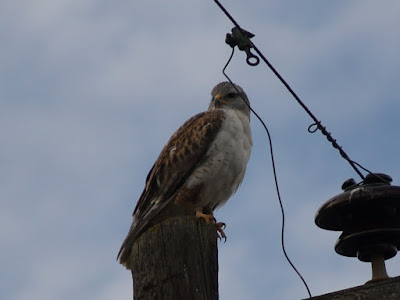
Taking advantage of a beautiful winter afternoon I dragged Patrick out of the house with me and we headed for the Huichica Creek marsh at the Napa River Marshlands. The sun was out and the wind was up a bit but it was really good to be out of the house and getting our feet muddy. There is a developed pond area near the parking lot that is heavily choked with cattails but has some open areas as well. We walked along the edge of this hoping to see the American Bittern that I had seen there previously. We continued out into the open fields beyond seeing where it would take us and eventually found ourselves cut-off by the marsh. Pat spotted a Short-eared Owl on the ground just before he took off and we saw several others. At one point we investigated a bush that had clearly been used by these owls for roosting finding guano, feathers, and even some owl pellets. We walked around the entire developed pond on the way back in and found some really good exposed parts where some patience will probably bring Soras and Virginia Rails into view. For this day we heard them calling in there but did not actually see any. When we left to make our way back home we went west on Las Amigas to Duhig and along Duhig we were astounded to find a Ferruginous Hawk. To my recollection I have only seen this bird one other time and it was in Mike Morris's backyard in Blue Lake, CA many years ago. To my regret I did not have a camera with me but both Pat and I had good looks and a chance to comment on the various field marks and convince ourselves. I posted this sighting on the Northbay birdlist and was quickly questioned about it's veracity. Being somewhat miffed about that I went back at about the same time the next day in hopes of finding it again and getting a few photos. Don't think I was wrong.

Wednesday, February 1, 2012
Timberhill Park - Napa CA
One afternoon this week I searched out a local city-administered piece of open space called Timberhill Park. It is located in the hills of west Napa and is a surprisingly beautiful, if small, slice of what this valley once was. At one time this would have been a part on someone's ranch. There are still grazing cattle in the area and evidence that what are now just tracks and trails for walking were once used by vehicles. It doesn't take long to walk the loop around the hilltop summit of the park, at a brisk pace it can be done in as little as a half-hour. But the view from the top of the knoll is quite nice. As I looked out over the valley I found myself doing what I always seem to do in these situations, wondering what it must have looked like before we put the stamp of human occupation on it. Long before the arrival of European and American settlers, the Native Americans used this land to their advantage but they did so in a far less invasive manner than first the Spanish then Mexican and finally Americans who settled here. I like to think of what it might have looked like pre-Clovis or pre-Solutrian if you subscribe to that theory. Imagine the view and what you would have seen if you were the first human to set eyes on this landscape.
As I completed my loop around the park I had noted only a few birds including Black and Say's Phoebe, a Savanna Sparrow, many Lesser Goldfinches, and a few Vultures. I had heard that you could see Varied Thrushes here and I had yet to see one in Napa County. The last part of the loop brings you back down into the gully that is the headwaters of Redwood Creek, a lovely woodland laced with the strong scent of the California Laurel. This is where I would find my Varied Thrush if there was one about, and low and behold there was. Moving through the trees ninja style, making no sound at all. Just a quick pose out of cover to say he was here and then gone. A nice bird that reminds me of wet winter days on the campus of HSU where I could always find one on the edge of the forest that was our neighbor.

Wednesday, January 18, 2012
Restoration Success Story
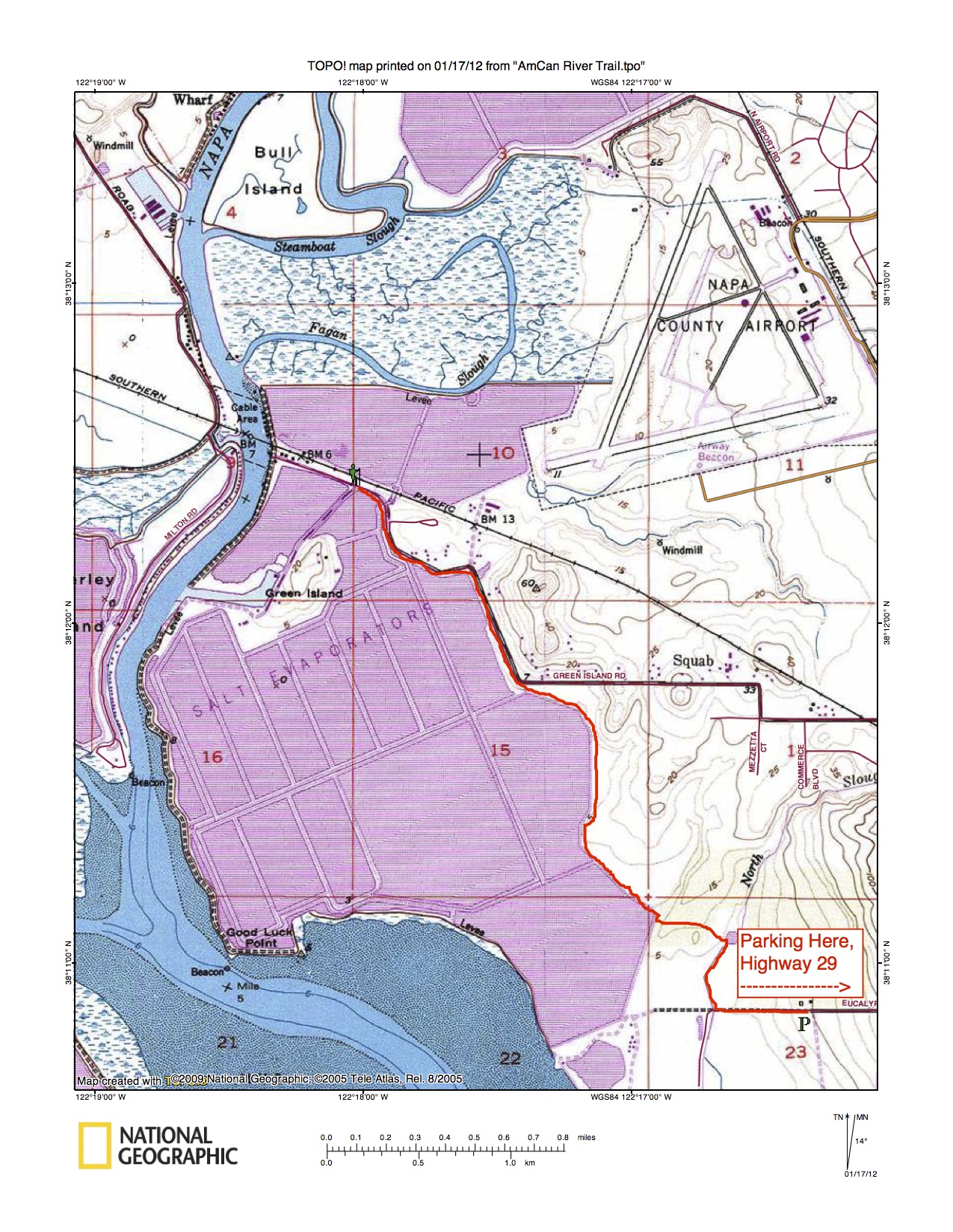
In Napa County where I live there is a vision of a bicycle/pedestrian path that will someday allow users to walk or ride virtually the entire distance between the city of Calistoga in the north and American Canyon in the south. That vision is slowly but surely materializing into reality. Already significant stretches of what is referred to as the Napa River Trail have been completed with more pieces in the works, while the Napa Valley Vine Trail begins to take shape having recently received significant grant awards. This past weekend Patrick and I took our bikes and binoculars down to American Canyon to ride the almost 3 miles of the newest portion of the River Trail. The trail runs north from the staging/parking area at the west end of Eucalyptus Drive along the edge of what used to be salt evaporation ponds that had belonged to the Cargill Corp. These ponds were sold back to the State of California and the Dept. of Fish and Game has done an exemplary job of restoration so that now they are tidal mudflats that are supporting more and more birds. Every indication is that the Napa/Sonoma Marsh system is now capable of supporting an increasing number of resident bird species as well as providing critical rest and nourishment to the millions of migrants who have and will continue to rely on it.
As we rode the trail the tide was on it's way out leaving much of the mudflats exposed and teaming with shorebirds. We had Dunlin, Dowitchers, Willits, Least Sandpipers, Western Sandpipers, Black-bellied Plovers, Black-necked Stilts, Avocets and a new county bird for me Semipalmated Plovers. We also had a nice look at a juvenile Peregrine Falcon on a roost near the parking area. I'll be returning soon when I have a bit more time and my scope so I can get some better looks at the plovers. You can access this portion of the river trail off of highway 29 in American Canyon opposite the large Walmart monstrosity. Follow Eucalyptus Drive west over Oat Hill to the parking area at the end.
Tuesday, January 10, 2012
An Uncommon But Regular Visitor

Since we moved to our house in 1998 I have kept feeders in the yard to attract a variety of bird species. As my yard list has steadily grown over the years and now and again I am able to add one more, there are a few visitors who return each year that I am particularly fond of. One of these is the White-throated Sparrow. Each fall as the temperatures begin to fall and I start to fill the seed feeders I wait for the arrival of this uncommon but regular winter visitor. There have only been two winters since 1999 that I have not had one spend the winter in the vicinity of our yard. This year I am lucky enough to have two of them. They arrive from somewhere north and east of us joining the White-crowned and Golden-crowned Sparrows to compete for the plentiful free food at my avian diner. I begin to look for them at Halloween and expect them to leave again by April, they are my winter residents and welcome. I don't know the life expectancy of these sparrows but I can't imagine that either of the two I have now is my original visitor from 1999 and this makes me wonder. Are they off-spring? If so, how is it that they find my yard every year? While the local Christmas bird counts turn up a number of these birds they are by no means common in these parts. Some of the field guides even say they are rare in our area which is well south and west of their breeding range. This leads me to believe that the White-throats who inhabit my yard each winter must be passing the news of good and plentiful food with only occasional fat cats and Sharp-shinned Hawk interruptions along to their chicks and that these birds all come from the same original visitor. How this is done is not known to me but perhaps those members of the professional wing (pardon the pun) of the brethren would have more to say about that, and perhaps I need to do more reading. In any case I enjoy their presence, I look for them every morning, seeing them always brings a smile. I will send them on their way in the spring with an invitation to return again in the fall and if they themselves can't make it back then I hope they have told the next generation about our yard.
Tuesday, January 3, 2012
Point Arena Harbor - Mendocino Coast

I have heard tell of the Laysan Albatross that is a regular winter visitor to Point Arena harbor in Mendocino County for several years now. For one reason or another I have not made the journey to see him/her. As I have rekindled my enthusiasm for birds and birding I resolved to see this bird this year. On December 5th the news came across the list serve that "Big Al" had indeed returned. Since we now have an extra week of winter recess before school starts again I convinced Danette and Patrick to go with me for a short trip to the coast and two cracks at Big Al the Laysan Albatross.
It is unusual for an Albatross to spend so much time in-shore as Big Al does. In general these birds approach land only during their breeding season so it is a rare treat for birders who don't like boats to see one of nature's greatest flyers. On our first day out we arrived at the harbor in the early afternoon and were greeted by cloudy and drizzly skies. We scanned the harbor for a while without success and then learned from the harbormaster that Al had been present that morning but had disappeared before noon. I think the harbormaster may have called him a ninja when describing how he turns up and then disappears for a while. We hung around for a little while then resolved to return the next day and try again. After staying the night in Ft. Bragg we were shocked to find the sun shinning the next morning and we high-tailed it south for another try for Big Al. It wasn't 30 seconds after leaving the car that we knew he was there. As I approached the pier there was a large gray and white seabird just outside the surf line 100 yards to the north. It was significantly bigger than the gulls in the vicinity and therefore could only be Big Al. A recent post on the CALBIRDS list serve discussed the history of this bird. He/she was first sighted in 1994 making this the 19th consecutive winter of visitation. I also recall reading that the Tsunami generated by the large earthquake in Japan was destructive to the nesting area of these birds on the Midway atoll. It is nice to see that this bird was not a casualty of that phenomena. I spent about an hour on the pier enjoying the beautiful day and this amazing bird.
Sunday, January 1, 2012
Huichica Creek - Napa River Marshlands
The last day of the year, cool and clear in the Northbay. I was recently contacted by a Napa couple who had seen a few of my posts on the NBB list serve and they suggested I visit Huichica Creek. There are a number of ways to access this Fish and Game managed area (click on the map image to see a pdf of the Napa and Sonoma Marshlands) and I assumed they meant from the HQ at the bottom of Duhig Rd. I drove out there near sunset to see if I could pick up some more Short-eared Owls and parked in the staging area. There is a small marsh area along the creek that might prove interesting later in the year but there is no established wildlife viewing area here. I walked out an access road and crossed the railway line and walked along a dike separating two large ponds. Here I found lots of waders and ducks as well as cormorants and a small group of Bonaparte's Gulls. No owls out here but there was a promising group of eucalyptus trees near the end of the dike. As I walked back I was treated to a spectacular sunset. I was without a camera so it will have to be preserved in my mind only. As I neared the farm buildings that serve as the unit headquarters and it was turning to dusk I scanned the openings on the ends of the barns and within a minute a Great Horned Owl flew out of the first and off to it's nocturnal business and then from the second a Barn Owl popped into view and flew off for the same. A fine way to end the year and a good omen for 2012.


Wednesday, December 28, 2011
Short-eared Owls on Skaggs Island
After receiving news from the Northbay Birds list-serve that Short-eared Owls were being seen in the Skaggs Island area, Pat and I drove the loop around the Napa River marshlands. This means going south on 29 to 37, going west to Sears Point, and then returning to Napa via Schellville and Ramal Road. We met two other birders on the bridge on the entrance road to Skaggs Island off of Hwy 37 and together waited for these owls to appear. On the way in we spotted a nice Peregrine Falcon that flew to the top of a power pylon and posed nicely. At about 4 we began to see the Short-eared Owls as they hunted the fields of Skaggs Island. The county lines are tricky here and by positioning yourself at different parts of the bridge you could see these owls in both Napa and Sonoma counties. Patrick enjoyed these birds although I did have to drag him to the truck to start the journey. Ah the power of a firm gentle nudge.
Tuesday, December 27, 2011
Pat Sees the Falcated Duck at Colusa

Today Pat and I got up early and drove over to Colusa NWR to see the famous Falcated Duck. Once again he was easily seen from the viewing platform which at one point later in the morning hosted as many as 25 people with their cameras and scopes. When we first arrived around 9 the light was perfect and the duck in excellent position. Every time he swam across the front of the island the light would show him to best advantage and the air became filled with the whirring and clicking of cameras and shutters. The excitement was palpable and Patrick was noticing the other species of waterfowl as well. After the excitement of this duck we headed out to drive the auto tour route and had an excellent morning of central valley birding. Our highlights were a really good look at an American Bittern, an adult Bald Eagle, and a Merlin feeding on a fresh Coot kill. We stopped once more on the way out for another look at the Falcated Duck and enjoyed the crowd on the platform.
From here we drove 15 miles into Sutter County to look for Mountain Plovers that had been reported in a recently plowed farm field. As is often the case they had remained right where people had been seeing them and even though most of the group of 10 or so was quite a ways across the field there was one within 200 yards that we were able to scope and get good looks at.
All in all a fun day (except for the speeding ticket I got on the way home). Patrick shows the signs of being an interested observer, very encouraging. Tomorrow we might try for Short-eared Owls in the southern marshes of the Napa River.
Subscribe to:
Posts (Atom)