The season of the winter solstice is a special one for so many reasons. Humans the world over celebrate this turn of the year in a variety of ways and in some cases have even changed their traditions to fit this season. For example, the co-opting of the season by the Christian faith so that the birth of Christ is celebrated at the same time as the pagan rituals marking the turning of the season and the gradual return of longer days. But for all observers of nature and the world around us (both secular and non-secular), the low angle of light from the sun and the shorter days can create conditions of breathtaking beauty. Nowhere is this more evident than here in our great state of California. Our state is nearly 10 degrees in latitude from top to bottom. At the southern end on the Winter Solstice we receive almost 10 hours of sunlight, at the northern end of the state only 9. And of course, as you move northward in the state and the latitude increases the angle of the sun striking the earth decreases. It is these low angle beams of sunlight, often passing above, below and even through clouds that create moments of extraordinary beauty in the landscapes around us.
View our shared photo album of this trip.
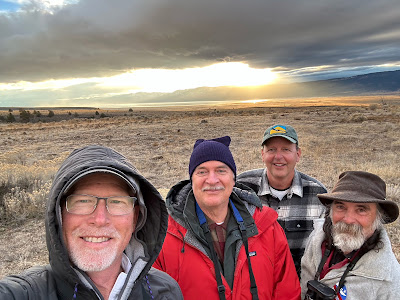
This past week my birding buddies and I returned to Modoc County, California's most northeastern county where we witnessed first-hand the magic of the low winter light conditions. For many years in the past I visited this region on a Thanksgiving weekend trip to Tule Lake and Lava Beds National Monument and it has been some time since I have returned at this time of year. Michael, Jeff and I had not gotten together to bird since our Arizona trip in May so this seemed like good timing for another adventure. Also joining us this time was Erik Blomquist, Jeff's good friend from his days teaching in Aromas, CA. We secured an AirBnb in Alturas (the Goose Loop Getaway) to serve as our home base for our 2 day stay (I highly recommend this approach as it was comfortable, convenient, and inexpensive).
We began our trip by meeting Michael at the Tule Lake National Wildlife Refuge headquarters. We were interested to note that they have built an entirely new headquarters building with a new visitor's center that will open early in the new year. For that first afternoon we followed our traditional approach by driving the auto tour route off of Hill Rd. We knew that this year Tule Lake and Lower Klamath had not received the water that they need to support the large flocks of birds we would typically see. On our way in from Highway 97 we saw first-hand that Lower Klamath was almost completely dry. Traveling the tour route at Tule Lake we passed sumps that are usually full of water and birds but not this year. It wasn't until we were nearly to the south end of the refuge that we encountered water that held ducks, geese, and swans. We did enjoy good looks at many raptors as we drove the route. Tons of Red-tailed Hawks, a pair of Cooper's Hawks, Ferruginous Hawks, Rough-legged Hawks, a couple of Bald Eagles, and a White-tailed Kite. We seemed to have all of the regular duck species to be found here: Mallard, Gadwall, American Wigeon, Pintail, Ring-necked, Ruddy, Goldeneye, Bufflehead, Green-winged Teal, Cinnamon Teal, Shoveler, Canvasback, Hooded Merganser, and one very obvious and beautiful Eurasian Wigeon. Usually it is the great numbers of geese that excites the birders who brave the chilly temperatures at this time of the year. While they didn't disappoint, their numbers were not close to what we have seen here in the past. By far the most were Snow Geese with a few Ross's Geese thrown in. Also present were Canada and White-fronted Geese. They were joined by at least 25 Tundra Swans, always a graceful and beautiful bird. Perhaps the most stunning of all the birds we saw that afternoon was a beautiful blue phase Snow Goose, once thought to be a seperate species, it is a dark bodied Snow Goose with a white head, spectacular in the afternoon light.
 |
| Tule Lake NWR |
Following our tour of the auto route we entered Lava Beds National Monument where we drove the main road through to connect with Highway 139. We were hoping to pick up some good Juniper/Pine forest birds to add to our list and on our way in we did see a Loggerheaded Shrike, however the main event of the Lava Beds tour was to witness the significant destruction caused by the Caldwell Fire in 2020. I had seen it the year after the burn and Michael, Jeff and Erik had not been to Lava Beds since the fire. I was hopeful that there had been some significant progress in the recovery; there was not. This landscape is a pretty resilient one but it is going to take a significant amount of time for it to recover to it's pre-fire state. However, with climate change there is some question as to whether or not it will ever reach it's pre-fire state. Will the same species repopulate the burn scar or will new ones, better adapted to a dryer/hotter climate replace them. Yet another thing to ponder as we make our way through the monument and then hit the road for Alturas and our base for the next 2 days.
Our Airbnb (the Goose Loop Getaway) wasn't fancy but was perfect for our adventure and the price was exceptionally reasonable. We settled in, made dinner, and crafted our plan for following day, all while the temperature was dropping outside to below freezing. In our younger days we would be camping at Lava Beds and freezing our butts off. The perks of retirement and older, creakier bones.
Our morning began with a scan around the property. Robins, Cedar Waxwings, Flickers, Quail, and Townsend's Solitaires made up our local residents. We then headed out to drive the tour loop at Modoc NWR. One of our reasons for coming to Alturas was the presence of water at this refuge. While other refuges in the area had many dry ponds and sumps Modoc had an abundance of it. What it didn't have was an abundance of birds. We managed 22 species here including our only Belted Kingfisher of the trip.
 |
| Modoc NWR |
Heading south on 395, we made for Likely, CA. and from here headed into Jess Valley tucked up against the west flank of the Warner Mountains. It's here where you can find the headwaters of the South Fork of the Pitt River. We have visited this valley on several occasions before and it is always worth it. For highlights we had between 7 and 10 Golden Eagles, a number of Rough-legged hawks and tried very hard to turn up a Juniper Titmouse for Jeff. We left Jess Valley by West Warner Rd. a dirt forest road that traverses the west flank of the mountains, visiting Mill Creek CG and then making our way north. We very well may have been the last vehicle on that road this season as it was pretty muddy and slippery and the next storm would surely make it impassable.
Coming down out of the mountains we had thoughts of lunch so made a quick stop at the Goose Loop Getaway, savored the smell of our cooking dinner, ate, and piled back in the truck for the last stage of the day - a trip to the other side of the Warners and Surprise Valley.
Surprise Valley in the extreme northeast corner of California might be one of the most remote and least visited sections of the entire state today, but it has an important place in the history of early emigration into the state. In 1846 the Applegate trail was established as a safer alternative to the Oregon trail for settlers heading for the Willamette River Valley. Coming from Nevada it crossed the Warner Mountains at Fandango Pass then turned north for the Oregon country. Then, in 1848, after the gold discovery, the Lassen Cut-off was created by Peter Lassen which took settlers south after crossing Fandango Pass down into California. This emigrant trail was heavily traveled until 1853 when the wagon road over Cedar Pass (modern day Highway 299) opened and the Lassen Cut-off shifted to this route. Many early California settlers, aware of the 1846 Donner Party tragedy, wished to avoid the high Sierra crossings and thus chose this route into the state. Here is an excerpt from the 1849 journal of Elijah Bryan Farnham describing his parties' approach to Fandango Pass:
"Commenced our travil along the border of the dry the lake bed of the through a grassy valley The tall Siera was on our left Covered with magnificent finery [pines?] along its whole extent There pines coverd hills contrasted well with those barren plains There were plenty of streams a running from the mountains The prospect was that our Suffering for water was over Camped on the eastern base of the mountain for the last time For to morrow by good luck we expected to cross".
 |
| Surprise Valley |
As we made our way over the Warners and down into Surprise Valley we were greeted by spectacular afternoon sunlight filtering through the piles of clouds covering the peaks of the the Warner Mountains. This valley is known for flocks of sparrows in the winter and is the one place in California where it possible to see a Bobolink (in spring). We were hoping to turn up something interesting as we drove the farm roads heading east towards Nevada. Instead we were struck by the paucity of birds, nothing like what we expected here. However, it wasn't a total bust. We had some incredible views of Ferruginous Hawks, both light and dark phased. It's rare that you get to see them together. We had a stunning Mountain Bluebird that seemed almost turquoise in the low afternoon light and we ended the day on a high note with a very sharp looking Prairie Falcon.
 |
| Jeff's shot of the Prairie Falcon. |
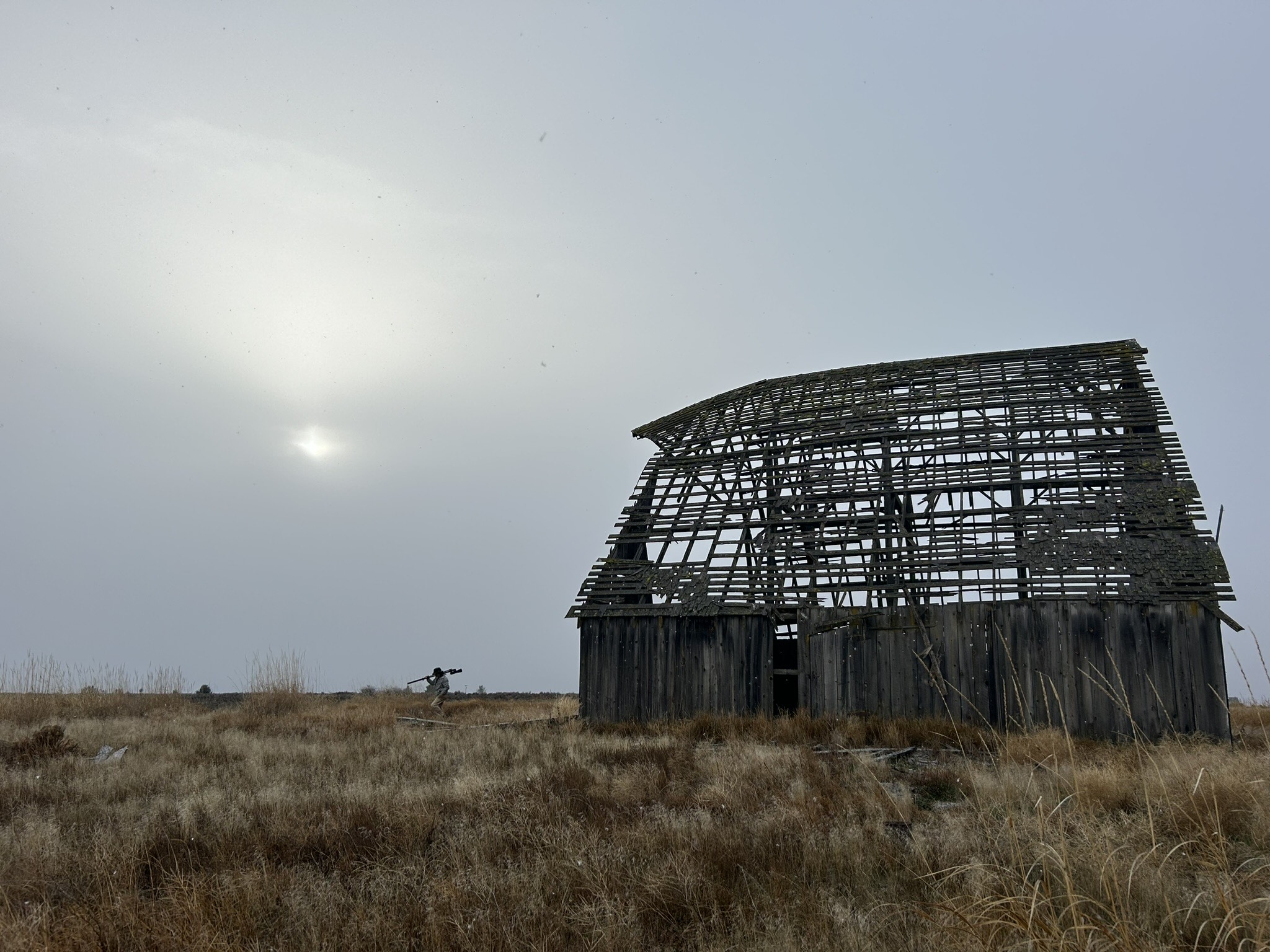
Our final day began with some weather as we made our way back south. Our plan was to follow Highway 299 back towards Redding where we would split up to return home. We encountered some snow flurries on the road as we went over the mountain to drop down into the valley that holds the town of Bieber and the Ash Creek Wildlife Area. Making a brief stop here we visited the Barn Owl that roosts in, of all places, a dilapidated barn, and saw a few other resident species. From here we went to the end of Rat Farm Rd. in McArther and Ahjumawi Lava Springs State Park. Again, not a huge number of birds but we did see several Tundra Swans, Ferruginous and Rough-legged Hawks, a Bald Eagle, Ring-necked Ducks, and a very cool American Bittern to name a few. This is a great place to visit and I would really like to return in the spring with Kayaks to properly explore it.
 |
| Michael & the Ash Creek Barn |
We stopped at the rest area where Hat Creek crosses Highway 299 and bid farewell to Michael. Then we headed south down I-5 for one more stop at Sacramento National Wildlife Refuge. Here the shear number of Snow Geese was the most impressive aspect of our quick visit. There were also large numbers of ducks and our only Wilson's Snipe of the trip. Jeff also pulled us out a nice Glaucous-winged Gull. I think that an argument can be made that because of the scarcity of water in the Klamath Basin, numbers of geese and ducks at the Central Valley refuges have gone up. Hard to prove but a reasonable supposition.
All in all, another great trip in the books. It gives me the itch to start thinking about other adventures we might have this spring.
A happy and joyous holiday season to all!