Monday, January 30, 2023

Central Coast Excursion

Mt. Clef Regional Open Space

Recently, Danette and I had a chance to spend a little time on the Central Coast in the Los Osos area. With all the hills in California displaying the lovely green color of early spring it seemed that everywhere I looked I was treated to beautiful views and spectacular scenery. During our time there we took a day trip down to Ventura to try and see a couple of King Eiders who have been present at the pier there. We had a fun day of it, enjoying the scenery a visiting Ventura.

Friday, January 27, 2023

To See, To Not See - That is the Question

Santa Cruz Sunset

There are no guarantees in birding. When trying to see a rarity, I always leave the house with a high level of hope but the reality is that more often than not, you don't see the bird you are looking for.
 Call it luck, timing, talent of the birder, karma, or the sometimes capricious nature of nature. The fact remains, sometimes you miss. Perhaps it was one of these reasons or maybe all of them that caused us to miss last Friday in Santa Cruz.

Tuesday, January 17, 2023

The First Rarity of the New Year

Our climate here can be a bit capricious. The fluctuations in our rainfall totals over the years reveals a truth about this state that many people don't realize. Water is the true gold of the State of California. After a series of very dry winters and an ongoing drought, we are seeing a return of the rain that used to be a characteristic feature during an average winter.

Monday, January 2, 2023

A Day Out In Kern County To End The Year


I always enjoy visiting my mother-in-law who lives in Bakersfield because it's nice to see her, but also because it gives me a chance to do some birding in Kern County. The area around Bakersfield where she lives gets a bad rap but I find it to be just as beautiful in its own way as other parts of California. It is true that there are times of the year when the heat and the want of much greenery gives it an oppressive and perhaps ugly visage, but for most of the rest of the year it is quite beautiful.

Saturday, December 24, 2022

Two New Additions and a Productive Fall

Merry Christmas and a Happy New Year to you all! As the year is coming to a close I have two new additions to my list to report. I think that the best part of retirement so far is the ability drop what I am doing when a rare bird shows up and take off to try and see it. That happened twice this month, both times within the city limits of Richmond. First, a small group of Nelson's Sparrows was found along the Bay shoreline at a place called Meeker Slough. I had not been to this part of Richmond before and it was really quite nice. A multi-use trail runs through the area and on down the Eastbay shoreline and the neighborhood was very attractive with lots of people out and about using the trail. Previous observations had provided a general idea of the location and after about 30 minutes of canvassing the area I found a pair of them working through the vegetation along the shoreline. A small sparrow of the Central Plains with some orange coloration in the face, they mostly winter on the Gulf Coast, however there is a small population that winters in the Bay Area. I guess it's not just people who come to California in the winter for the weather.
Nelson's Sparrow

A few days later came word of another lost wanderer, a Slaty-backed Gull. This gull is primarily an Asian species that makes regular appearances in Western Alaska. This one just chose the wrong Pacific Coast to follow in it's wanderings. I definitely owe this sighting to first, the birder who found it and second to the group of birders who had picked it out of the group of thousands of other gulls on the water just off the Bay Trail as it goes around the landfill/transfer station in northwest Richmond. To get to the spot where these gulls were you had to park near the transfer station office and then walk the Bay Trail around the landfill for a little over a mile. As I came around the corner and saw the thousands of gulls on the water I thought to myself that I was never going to find this one bird. But then on the other side of the inlet I saw a group of 6 birders and they looked like they were focusing on one area. When I reached them they were very helpful in showing me the bird and then we all took some time checking it's field marks and getting pictures. They then left for the walk back leaving me to get a few more pictures and in that time two other birders arrived and I was able to pass along the favor of pointing out the bird. One thing that I so much enjoy about birders and the birding community is the willingness to help one another that pervades any chase or chance meeting in the field. Rarely have I encountered individuals whose egos, competitiveness, or condescension have spoiled the atmosphere of the enjoyment of these magnificent creatures.
Somewhere in this flock is one Slaty-backed Gull

Slaty-backed Gull

With just over a week to go the possibility remains that I may yet add another species before the year is out. This is after all, the season of Christmas bird counts and they often turn up rarities. However, we are due to be hit with an atmospheric river this coming week which will probably dampen any efforts to get out and bird, but you never know. All told, this fall I added 8 species to my life list for a total of 551. They were Baird's Sandpiper, Northern Waterthrush, Long-tailed Jaeger, Eurasian Skylark, Willow Warbler, White Wagtail, Nelson's Sparrow, and Slaty-backed Gull. My best season for new birds in many years. I highly recommend retirement!
Happy Holidays to you and yours!

Monday, November 21, 2022

A Milestone

This past week I hit a milestone in my 40+ years of birding. Species number 550. Every year along the coast of California we seem to get a White Wagtail that has wandered down the Pacific Coast from Siberia. Maybe in L.A. or perhaps Santa Cruz. This year one appears to be roaming around the bay side of Marin county. First seen at Las Gallinas in San Rafael and lately in a marsh off Rowland Blvd. in Novato. Several weeks ago I tried for it without success at Las Gallinas so when it began being seen in Novato I took another trip over to see if I could see it. Once again I benefited from other birders being present and looking for the bird. When I parked and walked over to the group a young women had it in her scope and offered me a look. I then spent the next hour following it around as it was very actively fly-catching on the shores of the marsh. Other birders came and went and everyone had good but distant looks at this Siberian vagrant. 

White Wagtail


Wednesday, November 2, 2022

Fall Adventures

No doubt about it, it was hot and still summer in Napa but migration had begun. It seems to me that the shorebirds are usually the first to get going at this time of the year and in late August reports began to appear of Baird's Sandpipers in several locations in the Bay Area. Thus far this species has eluded me so when they were found at Miller/Knox Regional Shoreline I went to look for them. They were well described in both look and location so were easy to find and I enjoyed a good 10 minute photo session with them.

Baird's Sandpiper

A few days later another species I have been hoping to see, the Northern Waterthrush made an appearance at a local park in the Eastbay. This park is really an urban creek corridor and has turned up some interesting birds. My friend Jeff had seen this bird there the day before I tried for it so I had an idea where to look. Most of the sightings had come from a few hundred yards further west than Jeff's so I spent an hour checking all of the locations out with no luck. I had given up and was walking back along the creek and I stopped at Jeff's spot for a few more minutes and low and behold out he popped. Bold eye stripe, streaking on the breast and doing a bob like a dipper. I only got to see him for about 10 seconds and then he was back into cover but I was super excited that I finally got to add him to my list. 

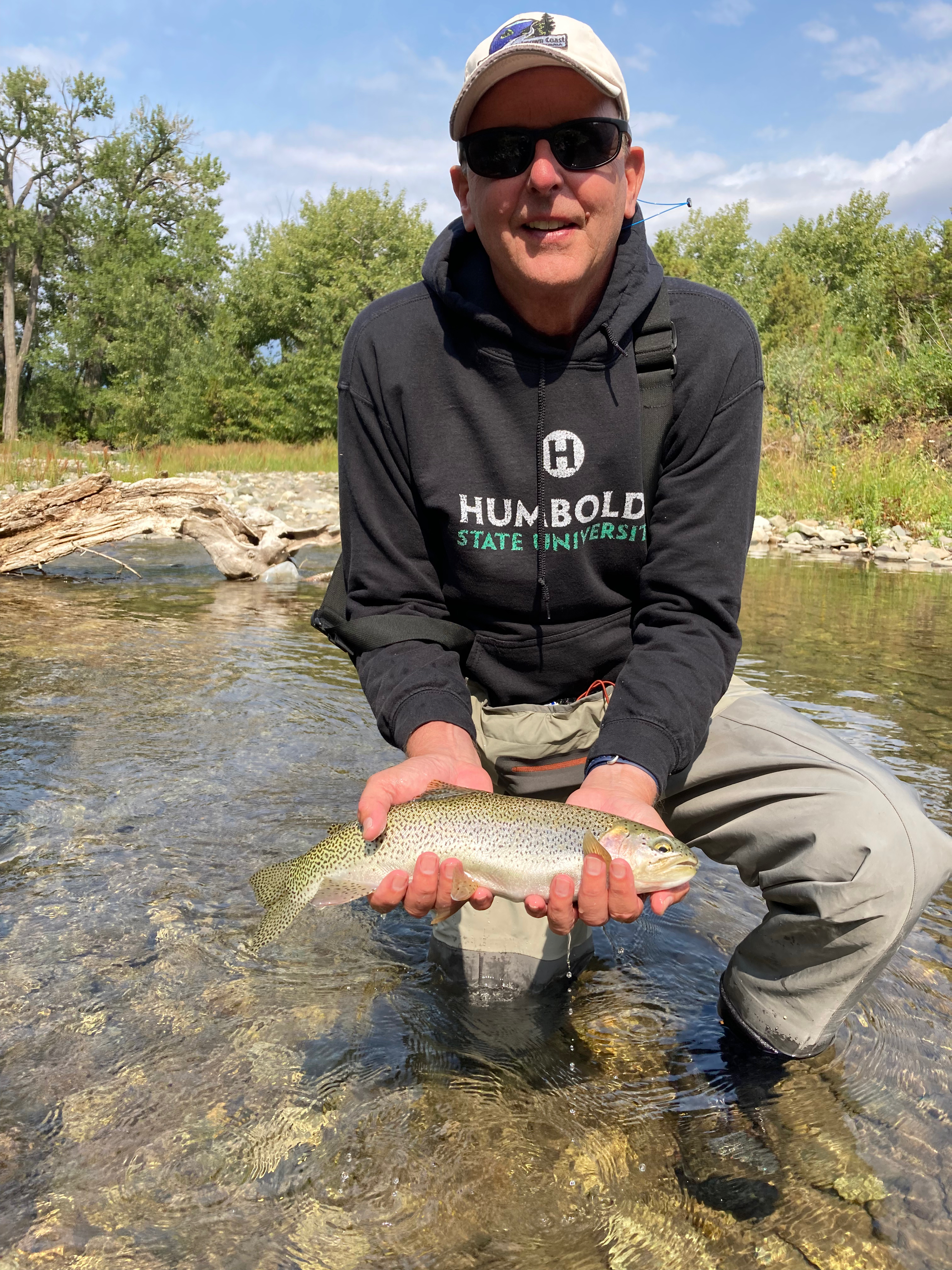
In mid September I had a chance to fly out to Montana to visit one of my oldest college friends Brian Kelly and do some trout fishing. I had not fished in some time and we had the most enjoyable time together. We caught some really nice fish and enjoyed the waning Montana summer.

Montana Rainbow

In late September, as summer began its slow retreat for the year, we spent a few days enjoying the glories of the Mendocino coast.  Taking our kayaks with us we spent a day exploring the Big River whose mouth is just south of the town of Mendocino. Our 7+ mile paddle took us into a beautiful riparian ecosystem.  Along the way we were accompanied by cormorants, kingfishers, herons and egrets along the water, and the usual resident passerines in the trees. Even though we had to work a little bit against the wind on our return it was a glorious day out.
Big River

On our last day in Mendocino (Oct. 1) I joined a pelagic trip out of Noyo harbor in Ft. Bragg. I had joined this trip three years ago and then the pandemic interfered during the last 2 years. It was fun to renew previous acquaintances and this time I was prepared for the sea with a scopolamine patch under my right ear. Hopes were high for the expected birds but with the ocean temperatures higher than normal some rarities were a distinct possibility. We were unfortunately engulfed in fog or clouds for most of the day and were not treated to any significant rarities. We did see Pink-footed, Sooty, and Buller's Shearwaters. Ashy and Fork-tailed Storm Petrels. Pomarine, Parasitic, and Long-tailed Jaegers (the Long-tailed was my one new bird on the day). Also present were Black-footed Albatros, Cassin's and Rhinoceros Auklet, South Polar Skua, and Northern Fulmar. Fun to be out there, fun to not be seasick, I am looking forward to a spring trip with this group.
Ft. Bragg Pelagic

As mid September rolled around Jeff came up to bird the Napa-Sonoma marshes with me. We put together a good checklist of shorebirds, gulls, terns and other residents of this unique marsh environment. The long conversion of salt evaporation pond back into natural coastal marsh continues here. This process has been fascinating to watch and gives one hope that nature, with a little help from us, can reclaim what is rightfully hers. Watching over this scene was none other than a wise old owl.
Great-horned Owl

Last year when Danette and I visited the Olympic Peninsula we had hoped to cross to Victoria to visit the famous Butchart Gardens, however Canada was not allowing Americans to enter their country so we had to put off that visit. This fall we planned to rectify that with a trip up to Vancouver Island to see the gardens and to play the tourist in Victoria. We spent a wonderful four days there and really enjoyed this incredibly beautiful place. I was able to slip away to the Victoria Airport to see the resident Eurasian Skylarks to add another species to my list but the best part of the bird show was whatever chanced to fly by our lovely accommodation right on the water in Saanichton. Loons, grebes, guillemots, geese, scoters and eagles all gave us a nod in passing.
Bald Eagle

So far this had been a successful fall with four new species to add to my life list but fate was not yet done with me. I usually pay pretty close attention to the rare bird alerts that pass through my email inbox and on October 18 they started to light up with news of a rare European warbler that only had been seen a couple of other times in the new world. This Willow Warbler was delighting crowds of birders at the western end of Rodeo Lagoon in the Marin Headlands and I did not want to miss it. This is one of the best things about retirement for me, I did not have to wait for the weekend to make the chase. I told Danette about the bird and she shooed me out the door to go find it. It's always fun to arrive at a spot where a rarity is putting on a show. All you need to do is to look for the huge camera rigs and spotting scopes and look where they are pointed. I literally pulled up, parked, opened my truck door, grabbed my binos, and there it was. I spent some time with the crowd following it as it forged in the brush and managed a few reasonable photos (nothing like what those giant lenses where getting though).
Willow Warbler

My final October adventure in the field took place in Bakersfield while visiting my mother-in-law. Over the years I have visited a spring in a clump of trees along Breckenridge Road which is an old stage road from Bakersfield heading east into the mountains. At this spot I have usually found Long-eared Owls. However, the last two times I have checked they have been absent. I made a quick dash up the hill to check and low and behold, there was one back in the trees. Nice to know that they still use this spot.
Long-eared Owl on Breckenridge Road

All-in-all it was a successful fall with five new species for my life list. 

  1. Baird's Sandpiper
  2. Northern Waterthrush
  3. Long-tailed Jaeger
  4. Eurasian Skylark
  5. Willow Warbler
That brings my North American ABA total to 549 species. I don't know that I will make it to 700 but it seems like it is worth a try.

Monday, September 5, 2022

In Search of the Himalayan Snowcock

The Ruby Mountains
It was hot. We had stopped for what we refer to as a’ Birding Lunch’ (sandwiches from the fixin’s in the ice chest) at an I-80 rest stop near Lovelock, Nevada. There was not a tree in sight and the only shade came from the metal awning built over the picnic table.  We were clearly in the desert as evidenced by the heat, the salt plain, the dry winds, and the lack of shade. This part of Nevada is right in the middle of the 40-mile waterless stretch that the emigrants on the California Trail had to cross in their heroic journey to a better life. Gazing around as we ate lunch, it is easy to see that we were in the middle of what is known as the Basin and Range Province, an area that includes much of the west from eastern California to western Utah. In the middle of this province sits the most mountainous state in the U. S. and in the middle of that our lunch spot. Most travelers in Nevada barely give this fact a second thought but it is true, there are over 120 named mountain ranges in the state and from where we sat we could see two of them, one on either side. I first became aware of the unique nature of this region from the book, Basin and Range by John McPhee. I say this because I discount a family vacation to Idaho in the early 70s which took us across the I-80 corridor. Back then these were just mountains and deserts that apparently couldn’t be fished. McPhee’s book, like all of his others, is a masterful work that makes it relatively easy for a layman like me to understand the basic principles of the topography and geology of the province.  In short, over the last 30 million years ongoing tension due to uplift is pulling the continental plate in an east-west direction which has led to the formation of parallel faults which are oriented north-south. As the plate stretches, fractures and thins, faulting causes mountains to rise and valleys to fall - the basins and the ranges. Jeff and I had come to the province on a mission, for in one of the highest and most scenic of the ranges, the Ruby Mountains, there lives a bird that can only be seen in North America within the confines of the higher slopes of the range - the Himalayan Snowcock. These birds were introduced into the Ruby’s in the early 1960s to provide sport for the region’s hunters and hopefully to draw some tourism dollars to the area. Snowcocks stay almost entirely above treeline and as a result few of them are actually hunted each year. Nevada Fish and Game officials in the 1960s probably had no inkling that the impact on the local economy from the introduction of these birds would not come from hunters but from birders traveling from all over to add them to their life lists. We were two such birders and, to our good fortune, we were joined by a third, Michael Morris who was traveling from his home in Eureka to Wyoming for a well-earned vacation from his life of retirement on the North Coast. Jeff and I left Napa early on the morning of August 17th and we took advantage of our crossing of the Sierra to go after his nemesis - the Mountain Quail. In the area of Yuba Gap (where I spent 2 summers at Boy Scout camp) is a road into a PG&E reservoir called Lake Valley Road. There had been recent reports of the quail so we took some time to check it out. This area appears to have been burned over a number of years ago and it proved to be a great birding spot. Highlights here included Williamson’s Sapsucker, Western Tanager, Townsend’s Solitaire, White-headed Woodpecker, and yes MOUNTAIN QUAIL!
Leaving the mountains of California behind we arrived in Lamoille Canyon in the Ruby Mountains which is just to the east of Elko.
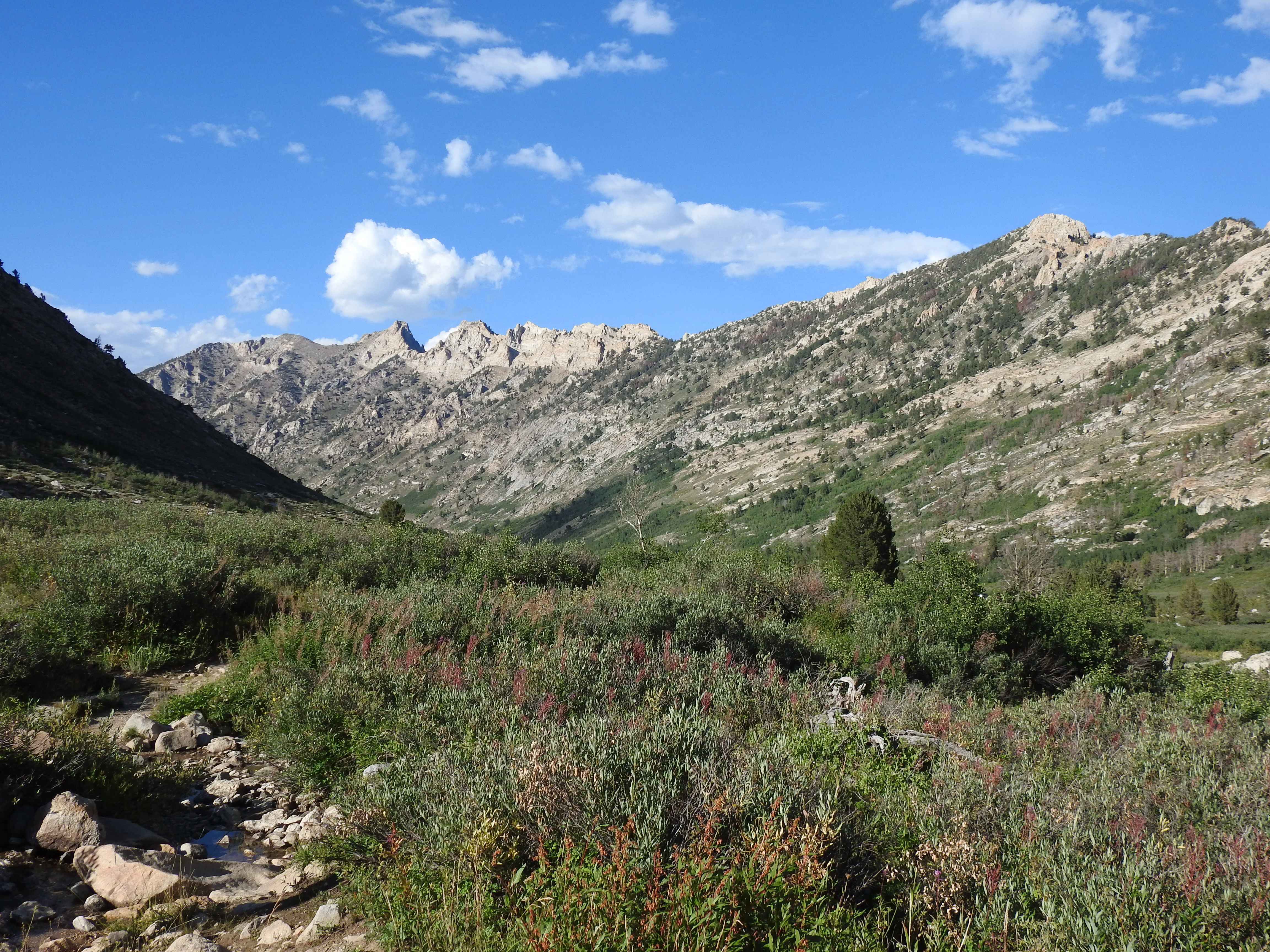
Upper Lamoille Canyon
I really can’t say enough about the beauty of this canyon. Approaching on the highway it is visible as a slash or a crack in the range, very narrow and not too hard to miss. As you enter and move up the canyon it alternates between very narrow, steep (vertical) sides and more open sections covered in aspens. At road’s end you find trailheads up to Lamoille Lake and Island Lake, both about 2 miles long and in excellent condition. The following morning we would make the hike to Island Lake in our quest for the Himalayan Snowcocks. We found Michael at his campsite and continued birding our way up the canyon picking up Western Wood Pewee, Lewis’s Woodpecker, Mountain Bluebirds and a really nice pair of Golden Eagles to name a few. We then headed back down to Lamoille for dinner and to iron out our plan of attack for the morning. The alarm rang at 3 am the next morning and we crossed our fingers and hoped for good luck. Starting up the trail at 4:15, we really didn’t need our headlamps as the moon provided plenty of light. Most people who are lucky enough to spot the Snowcocks do so shortly after dawn as they move from the ridge tops down to feed. We were in position above Island Lake in time to enjoy a beautiful sunrise.
Ridgeline Above Island Lake
We scanned and we scanned, surprised to see a Mountain Goat and then shortly after 6 am we heard a few Snowcock calls. Unfortunately, that was going to be the best we could do. We stuck to it but after several hours neither of us had a glimpse of these birds. As we retreated we did pick up some nice birds including Lazuli Bunting, Yellow and MacGillivray’s Warblers, Mountain Chickadees, and a Rufous Hummingbird. The rest of the day would take us a few miles to the west and South Fork Reservoir. It was quite hot with occasional cloud cover relieving us. Here we added waterfowl species as well as Sandhill Cranes and a nice Cooper’s Hawk. As we left the area and headed back towards Lamoille it was quite clear that we were going to get some weather.  Driving across Nevada the last thing you think about is rain, however, it is a little known fact that the Ruby Mountains receive nearly 50” of precipitation in an average year. We were about to get a taste of one form this can take - the thunderstorm. Late afternoon in Lamoille was a show of thunder, lighting, and copious amounts of falling water, what a show!

The next morning we were up early again in hopes of getting a glimpse of the Snowcocks. We employed a different strategy this time, setting up our scopes in the valley below the large rock wall where we had heard them the morning before. But alas, not a whiff. Oh well, that just means we are going to have to come back to the Rubys to try again, not a displeasing notion.
Scanning the Cliffs
Ever since we arrived in the region and the locals discovered that we were birders we were asked if we had gone to “the marshes.” Even the Nevada highway patrolman who pulled me over to remind me of the speed limit asked me this question. We had no idea what they were talking about. It turns out that they were referring to what I can only describe as a crown jewel in the National Wildlife Refuge system - Ruby Lake. I had never even heard of this refuge and it is no surprise as it is known as perhaps the most remote refuge in the lower 48 states. Tucked along the east side of the Ruby Mountains and fed by springs and runoff, this place took our breath away. Miles of wetlands in the middle of the Basin and Range province, its beauty was sublime.
Pronghorn Antelope Grazing in the Refuge
Our list of birds in the refuge was not overly impressive but a return at the right time of year could be epic. Our best stop of the day came on the way over the mountains to the east side in the canyon a couple of miles up from the valley floor. Here we ran into a mixed flock that included Blue-gray Gnatcatcher, Vesper Sparrow, Bullock’s Oriole, Western Tanager, Woodhouse’s Scrub Jay, Green-tailed Towhee, and Dusky Flycatcher to name a few.
The Birder's Lunch
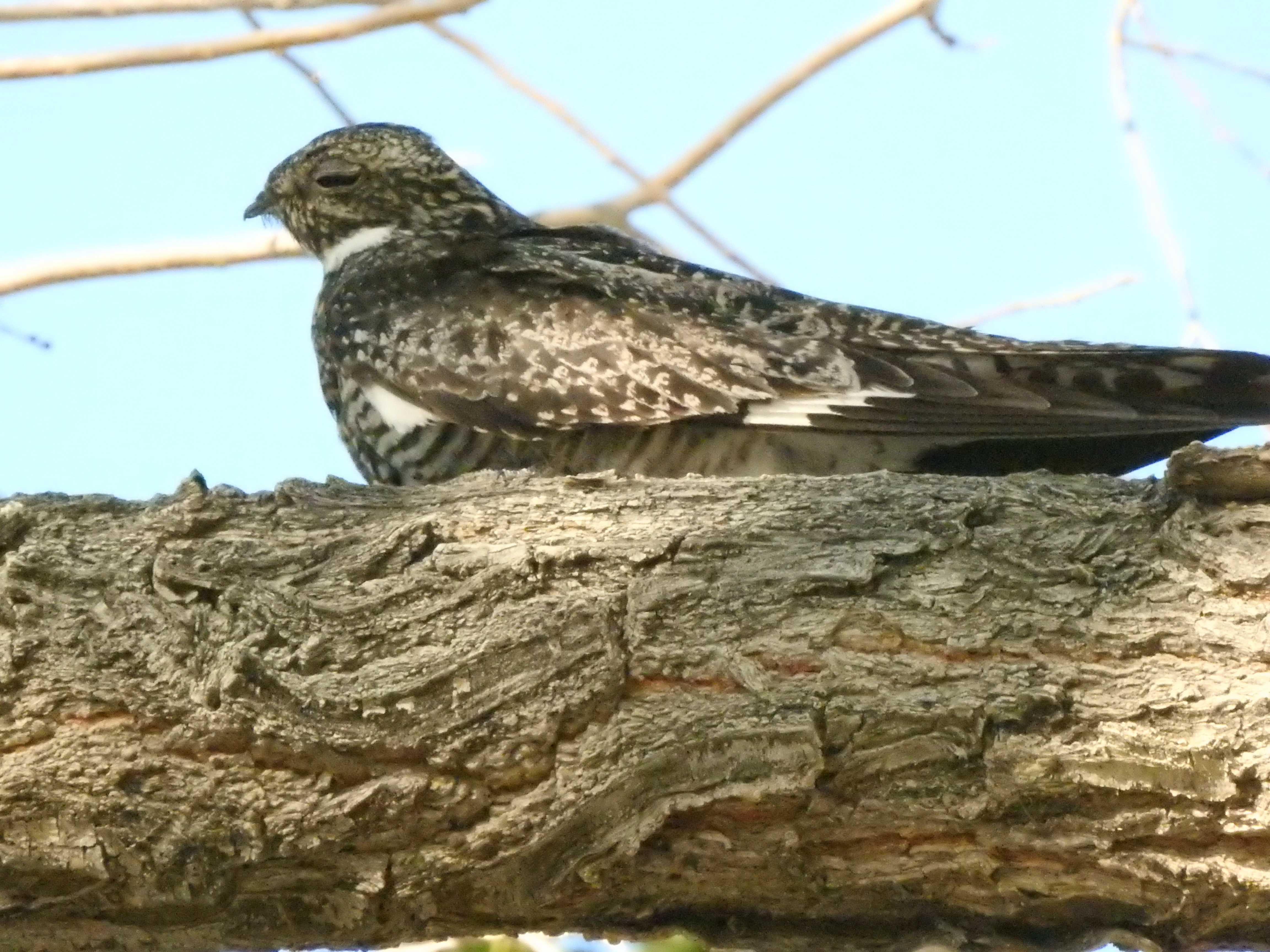
Enjoying another Birder’s Lunch at the refuge headquarters we noticed a plaque by the side of the road commemorating a campsite used by the ill-fated Donner Party in 1846. It suddenly struck me, we were on the Hastings cutoff, the unreconnoitered but heavily promoted alternate route to California that cost many of that party their lives. Gazing at this landscape you could not help but to admire the courage and fortitude of the people who came overland to California in that great westward migration. We would return to the west side of the range by way of a pass called “Secret Pass” where a Badger bid us adieu as it darted across the road in front of us. Arriving back in Lamoille it was time to part ways with Michael, he would be off to Wyoming and Jeff and I would start our trip back to California. As Jeff and I traveled the interstate we had one more surprise in store for us. At a rest stop in Valmy we found a tree full of sleeping Common Nighthawks. I don’t think I have ever seen them at rest before, fitting it was at a rest stop.
Common Nighthawk
Even though we did not get our target bird we had a great time in an area of stunning beauty. I am sure we will be back next spring. To finish off our trip we stopped at a disc golf course outside of Truckee to decide who would own the bragging rights. I humbly bestowed them upon Jeff, I will get my revenge next time!